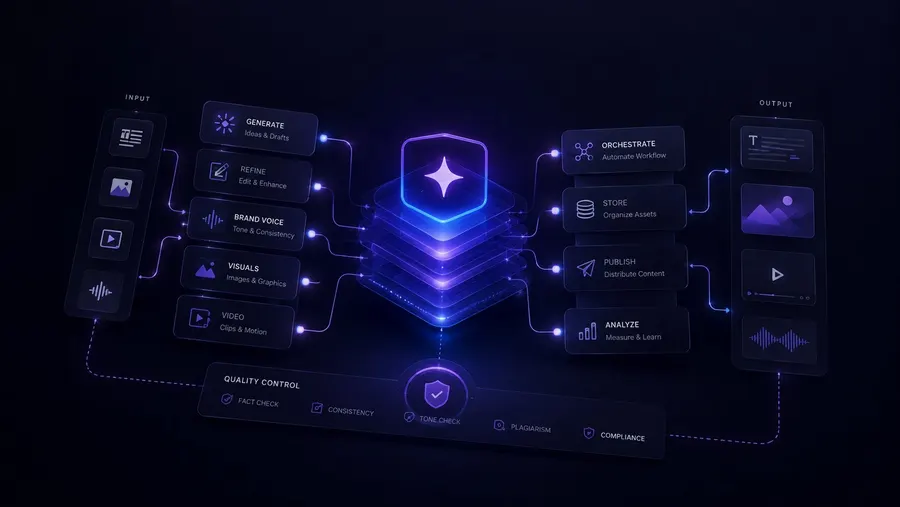
The Gradient Prompting Method: A Framework for AI-Powered Marketing

There's a phrase I keep coming back to: "No perfect tool exists — only perfectly built workflows." It sounds like something a project manager would put on a mug. But after years of building AI-powered campaigns for global brands, I've found it to be the most honest thing anyone can say about generative AI in marketing.
The brands that are winning with AI right now aren't the ones with the biggest budgets or the flashiest tools. They're the ones who've built a system — a repeatable, intentional way of moving from idea to output. That's what the Gradient Prompting Method is about.
Why Most Marketers Are Prompting Wrong
Most people treat AI like a search engine. They type a vague request, get a mediocre result, and conclude that AI "isn't ready for marketing yet." But that's not an AI problem — it's a prompting problem.
Think of it this way: if you hired a senior copywriter and your brief was "write me something good about our new product," you'd get garbage. The same is true for AI. The quality of your output is directly proportional to the quality of your input — and the quality of your input depends on understanding what stage of the creative process you're actually in.
"Maximizing the potential of AI begins with understanding how to ask the right questions."
The Three Phases of Gradient Prompting
The framework has three phases, and the mistake most people make is treating all three as the same thing.
Phase 1: Ideation
This is the divergence phase. You're not looking for polished outputs — you're looking for angles, directions, unexpected connections. Tools like ChatGPT, Claude, or Gemini work brilliantly here. The prompts should be open-ended, exploratory, and deliberately broad.
- "What are 10 campaign angles for a sustainable sneaker brand targeting Gen Z in Southeast Asia?"
- "Give me five unexpected brand partnerships that could work for an AI accounting tool."
- "What emotional territory does a 60th anniversary luxury car brand own?"
At this stage, don't edit the AI's output. Read everything. Some of it will be generic. Some of it will spark something.
Phase 2: Refinement
This is where gradient prompting gets its name. You're not starting over — you're turning up the specificity, one layer at a time. Take the ideas that resonated in Phase 1 and push them forward.
For visual work, this is when you move from concept into image generation tools. For copy, you push the AI to develop a specific angle with specific constraints: tone, platform, word count, audience.
Refinement prompt example: "Take the angle 'nostalgia as a Web3 gateway' and write three different opening lines for a Lamborghini NFT announcement. Tone: confident, not crypto-bro. Audience: existing Lamborghini owners who are skeptical of digital assets."
Phase 3: Implementation — The 4C Framework
Once you've found your direction, it's time to produce. This is where the 4C Prompt Framework comes in. Every production prompt should contain:
- Context — Who are you, what's the product, what's the situation?
- Command — What exactly do you want the AI to do?
- Constraints — Format, length, tone, platform, what to avoid
- Criteria — What does good look like? What's the benchmark?
Apply this to writing, image generation, video scripting, and social copy. The more precisely you define your criteria, the closer the output lands to what you actually need.
The Honest Truth About AI in Marketing
The future of GenAI in marketing isn't about spectacle — it's about producing believable, everyday content that fits seamlessly into real social feeds. As the line between authentic and AI-made blurs, brands should focus on realism, context, and transparency.
Keep it photoreal. Stay honest. And let creativity stay human. The AI is the amplifier. You're still the signal.

If you want to go deeper on any of the phases — or if you're trying to build this kind of workflow for your own team — reach out. This is exactly the kind of work I do with brands and agencies at SYS.Studio.
Get the next post
New essays on AI, creative technology, and building at the edge. No spam, unsubscribe anytime.
Powered by Substack