The Automation Stack I Use to Run an AI Content Studio
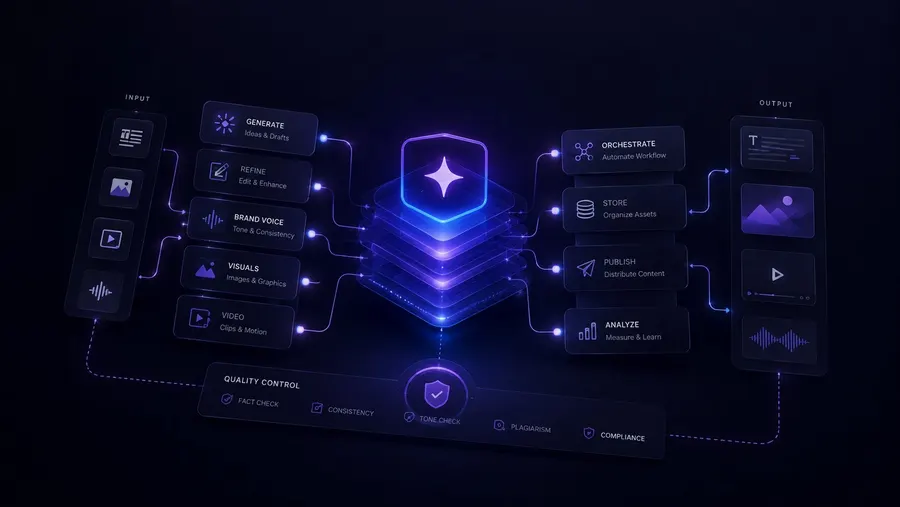
People ask me what tools I use. The honest answer is: the tools change constantly. What doesn't change is the architecture — the way I've wired everything together so that AI does the repeatable work and I do the judgement work.
Here's the stack, as of 2026. No affiliate links. No sponsored mentions. Just what actually works.
The Principle First
Before the tools: the goal of an AI content studio isn't to produce content faster at lower quality. It's to produce consistent, high-quality content faster than a traditional team could — without losing the brand voice that makes it worth reading in the first place.
That means every tool in the stack has to serve one of three functions: generate, refine, or distribute. If a tool doesn't fit cleanly into one of those, it's friction, not infrastructure.

The Stack
Generation Layer
Claude — my primary writing model. Handles long-form content, brand voice consistency, complex prompts with nuanced constraints. I've found it significantly better than alternatives for anything that requires sustained reasoning or tone-matching across a long document.
ChatGPT / GPT-4o — ideation and iteration. Better for rapid brainstorming, generating variations quickly, and tasks where I want to see a wide spread of options fast.
Midjourney — static visuals. Still the best for high-quality editorial imagery when I control the prompt precisely. Paired with ComfyUI for workflow automation and consistency across image sets.
AI video tools (Runway, Kling, Seedance) — rotating based on what the brief requires. This category is moving fastest; what I recommend today may be outdated in 90 days.
Orchestration Layer
N8n — the backbone of the automation workflow. Self-hosted, which matters for client data. Connects everything: triggers, API calls, content routing, notification logic. If you're building a serious content operation and you're using Zapier for everything, N8n will change your life.
Make (formerly Integromat) — for simpler client-facing automations where I need a UI they can operate themselves without touching the N8n instance.
Practical note: N8n has a steeper learning curve than Zapier or Make but rewards the investment. For anything processing more than a few hundred items per day, or requiring custom logic, there's no comparison.
Brand Voice Layer
This is the layer most people skip and then wonder why their AI content sounds generic. Every client gets a brand voice document — not a style guide PDF that lives in a folder, but a structured prompt system built specifically for the LLM.
It includes: tone descriptors with negative examples, sentence structure preferences, vocabulary inclusions and exclusions, and sample outputs marked "this / not this." This document goes into every generation prompt as a system-level constraint. Without it, the AI writes for everyone. With it, it writes for the brand.
Quality Control Layer
A human reviews everything before it publishes. That's not a limitation of the stack — it's a design choice. The AI produces the first draft and sometimes the second. A human makes the call on what's actually good enough to represent the brand.
The efficiency gain isn't from removing human judgement. It's from removing the blank page, the first draft friction, and the mechanical parts of content production. The judgement work is still human. It's just faster because the raw material is already there.
What This Actually Costs
For a studio operating at volume, the tool costs are relatively modest — a few hundred dollars a month across subscriptions. The real investment is setup time and the expertise to build the brand voice systems correctly. Done well, it produces content at a quality and volume that would require a team several times the size to match manually.
If you're building something similar and want to compare notes — or if you need help setting this up for your brand or agency — let's talk.
Get the next post
New essays on AI, creative technology, and building at the edge. No spam, unsubscribe anytime.
Powered by Substack