The AI UGC Machine: Why Everyone Is Building It, and What It's Actually Selling
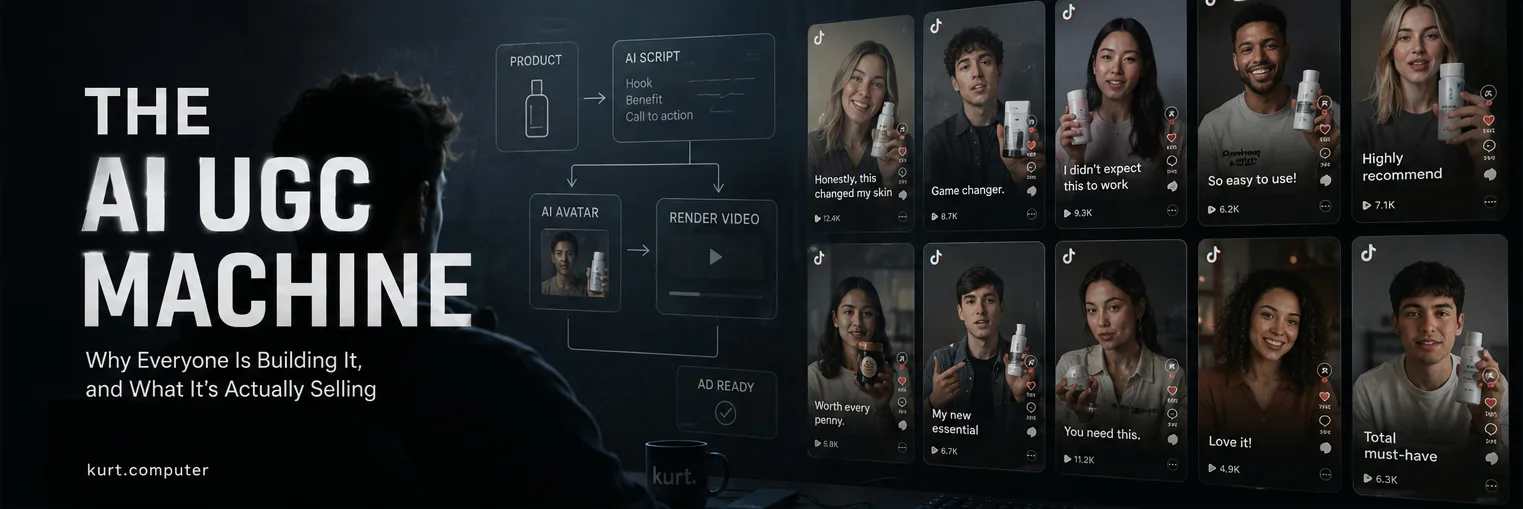
Every week, a new tool drops. Talking heads. Synthetic testimonials. A person you've never met, holding a product they've never used, saying exactly what the brief asked for. Generated in minutes. Shipped to Meta. Optimised for CTR.
It works. That's the uncomfortable part.
What is AI UGC — and why is it everywhere right now?
AI UGC (AI-generated user-generated content) is synthetic video or image content built to look like organic creator testimonials. The kind of content that used to require a real person with a real opinion and a ring light.
Now it doesn't. Tools like Creatify, HeyGen, and Arcads have made the pipeline almost frictionless. Upload your product, pick an avatar, generate the script, render the video. Done. The whole thing can cost less than a coffee.
The reason these tools are multiplying fast is simple: UGC-style ads have been outperforming polished brand content for years. Authenticity — or the appearance of it — converts. If you can manufacture that appearance cheaply at scale, the business math writes itself.
Is this actually a profitable business?
Yes. And it's only accelerating.
The global UGC platform market is projected to exceed $7 billion by 2028. The performance advertising market is far larger. AI UGC tool companies don't need to own the whole pie — they just need to sit inside the workflow of every brand manager running paid social. That's a very good place to be.
The SaaS model here is close to perfect:
- Low marginal cost per render
- High volume demand — brands need fresh creatives constantly to fight ad fatigue
- Easy ROI justification — if a $50 render outperforms a $5,000 shoot, the pitch is obvious
- Subscription stickiness once it's inside someone's workflow
The incumbents are already at significant scale. The follow-on companies are competing on avatar quality, voice naturalness, and speed. This is not a bubble. This is infrastructure being built.
But here's the more interesting question: what happens when everyone has access to the same infrastructure?
The believability problem
Right now, AI UGC works partly because audiences haven't fully calibrated to it yet. The uncanny valley is still wide enough that a well-produced synthetic ad can pass. Especially in a fast scroll.
That window is closing.
People are pattern-matching faster than the tools are improving. Comments on ads are already full of "this is AI" tags. TikTok users can spot a synthetic creator in seconds. The same audience that made UGC ads effective — people who trusted the person holding the product — is becoming deeply skeptical of anyone holding a product.
The irony of AI UGC is that it's trying to manufacture the one thing it can't manufacture: genuine trust.
The brands that will win aren't the ones generating the most content. They're the ones whose content still feels like it came from a real place — a real person, a real opinion, a real experience. AI doesn't eliminate the need for authenticity. It just makes it harder to find.

What the future actually looks like
I think we end up in two places simultaneously.
One: commoditised performance content. The bottom of the funnel — direct response, price-led, high-volume ads — gets almost entirely synthetic. Performance marketers won't care. It's not about who's talking. It's about whether the number goes up.
Two: real creators become more valuable, not less. At the top of the funnel, where brand trust is built, the premium on actual human voices goes up. Because when everyone's feed is synthetic, the genuine article stands out.
The middle — the "authentic influencer" running AI scripts — gets squeezed out. That's probably a good thing.
This isn't the death of advertising creativity. It's a sorting mechanism. The tools are now so good that technical execution is no longer the barrier. What's left is the question of taste, intention, and whether you actually have something worth saying.
Food for thought
If you're building with these tools — or deciding whether to — a few questions worth sitting with.
What do you want the relationship between your brand and your audience to actually be?
If you're optimising for clicks, AI UGC is a legitimate tool. Use it deliberately. Measure it honestly.
If you're optimising for something longer — trust, community, reputation — then the question isn't whether AI UGC works today. It's whether it builds the thing you actually need.
The technology is neutral. The strategy isn't.
I'm watching this space closely — not because I think it's going to destroy advertising, but because the decisions brands make in the next two to three years about how they use these tools will define what their audiences think of them in ten.
As a consumer: does the source of a testimonial still matter to you?
Get the next post
New essays on AI, creative technology, and building at the edge. No spam, unsubscribe anytime.
Powered by Substack