Content Isn't Getting Cheaper. Clients Just Stopped Paying for It.
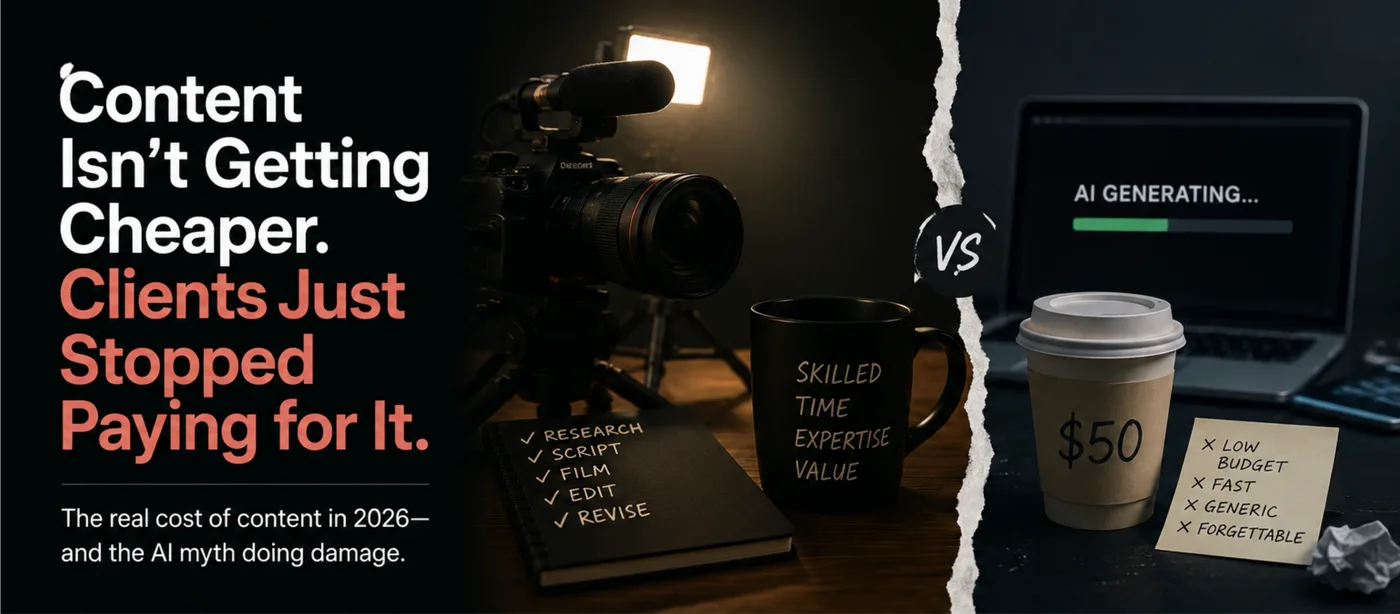
Somewhere along the way, a brief became normal that goes like this: "We need a 60-second UGC video. Product showcase, natural feel, authentic tone. Budget: $50."
Fifty dollars. For a video that requires a human being to understand the product, write or improvise a script, film it, light it, mic it, edit it, revise it, and deliver it in a format the client didn't bother to specify.
This is not content getting cheaper. This is clients deciding that creative work no longer deserves to be paid for. They reach for "AI can do it anyway" as the justification.
It can't. And I want to explain why.
What does a UGC video actually cost to make?
Let's be specific, because vague arguments don't change minds.
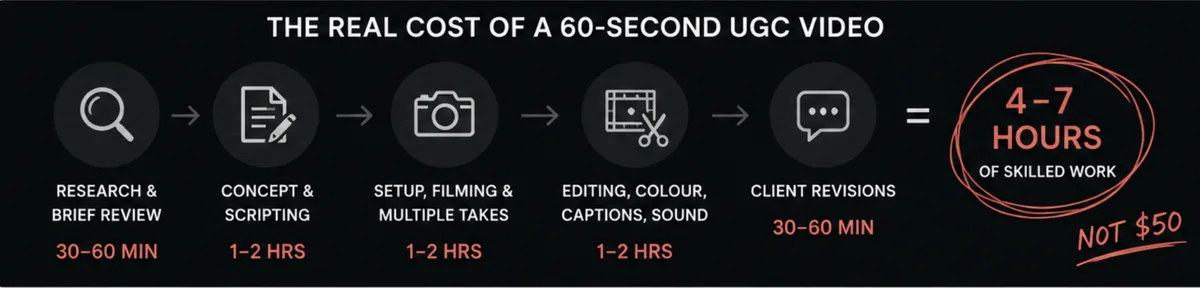
A single 60-second UGC video, the kind brands request every day, involves:
- Research and brief review: 30 to 60 minutes
- Concept and scripting (even "natural" content has a structure): 1 to 2 hours
- Setup, filming, and multiple takes: 1 to 2 hours
- Editing, colour, captions, sound: 1 to 2 hours
- Client revisions, usually at least one round: 30 to 60 minutes
That's 4 to 7 hours of skilled work. For $50. That's less than minimum wage in most developed markets. And this is a person with a camera, a built audience, an understanding of platform psychology, and the ability to make a product feel desirable on screen.
The rate isn't reflecting the cost of the work. It's reflecting the client's assumption that the work has no cost.
Why low rates produce bad content — and brands end up paying twice
Here's what actually happens when you lowball a creator.
The good ones don't take the brief. They've done the math. They know their time. They move on to clients who understand value.
The brief gets picked up by someone who's still building: less experience, less judgment, less understanding of what makes content actually work. They film something in twenty minutes. It looks cheap because it was cheap. It gets posted. It performs like it cost $50.
The brand says: "UGC doesn't work for us."
The content didn't fail. The budget did. And the brand paid twice. Once for the bad video, and again in lost performance.
There's a longer damage here too. When $50 becomes the accepted rate, when enough brands push it and enough creators accept it out of desperation, it poisons the whole market. It signals to the entire industry that this work is worth nothing. The talent leaves. The quality floor drops. Then clients wonder why the creator economy stopped producing interesting work.
The AI myth: "It's cheap now because AI can do it"
This is the belief doing the most damage right now. So let's take it apart.
AI content creation is not cheap.
The tools alone: Runway, Sora, Midjourney, ElevenLabs, Kling, and the stacks needed to connect them. They cost real money at any meaningful production volume. A serious AI content workflow running at scale can easily run hundreds to thousands of dollars a month in subscriptions, before a single human has been paid.
But that's not even the main cost. The main cost is this:
- Someone has to know which tool to use and when
- Someone has to write prompts that produce on-brand output, not generic noise
- Someone has to design the workflow so it's repeatable
- Someone has to review every output with editorial judgment
- Someone has to catch what the model got wrong: the off-brand line, the uncanny detail, the tone that doesn't match the audience
That someone is a skilled human. They are just doing different work than before.
AI does not remove the need for taste. It exposes the lack of it.
Anyone can generate a video now. Anyone can produce fifty variations of a caption. What you can't automate is knowing which one is right. Which one has a voice. Which one will land. Which one actually says something worth remembering.
That judgment is still human work. It still has a cost. Pretending otherwise is how brands end up with feeds full of content that looks like it was made by something that has never felt anything.
So what does good content actually cost in 2026?
With or without AI, the real cost of content has always been the same two things: time and expertise.
AI changes the shape of the work. It compresses some tasks and creates new ones. A skilled content strategist using AI can produce more in a day than they could before. But they are still the one making the decisions. They are still the one who knows what "good" looks like for this brand, this audience, this moment.
Good UGC from a real creator: $300 to $800 per video is a reasonable professional rate for skilled work. Some creators command more, and rightly so.
Good AI-assisted content at production volume: budget for tools, budget for the strategist or creative director running the workflow, budget for quality control. The per-unit cost can come down. But only because you're paying for expertise upfront to build the system.
The brands getting this right are not the ones finding the cheapest option. They're the ones who understand that content is a cost of customer acquisition. Cheap content costs more in the long run than you saved at the brief stage.
Food for thought
If you're a brand: the next time you send a $50 brief, ask yourself honestly what you're communicating about how you value creative work. And whether that's the kind of relationship you want with the people making things for you.
If you're a creator: the $50 brief is a signal, not an opportunity. Your time has a floor. Know it.
If you're building AI content tools: the conversation you need to be having with clients isn't "look how cheap this is." It's "look how much further your budget can go when it's spent intelligently." That's a different pitch. And a more honest one.
Content was never cheap to make well. We just got comfortable pretending it was.
What's the lowest rate you've seen offered for creative work — and did you take it?
Get the next post
New essays on AI, creative technology, and building at the edge. No spam, unsubscribe anytime.
Powered by Substack