The Biggest Impact of AI Won't Come From Smarter Models
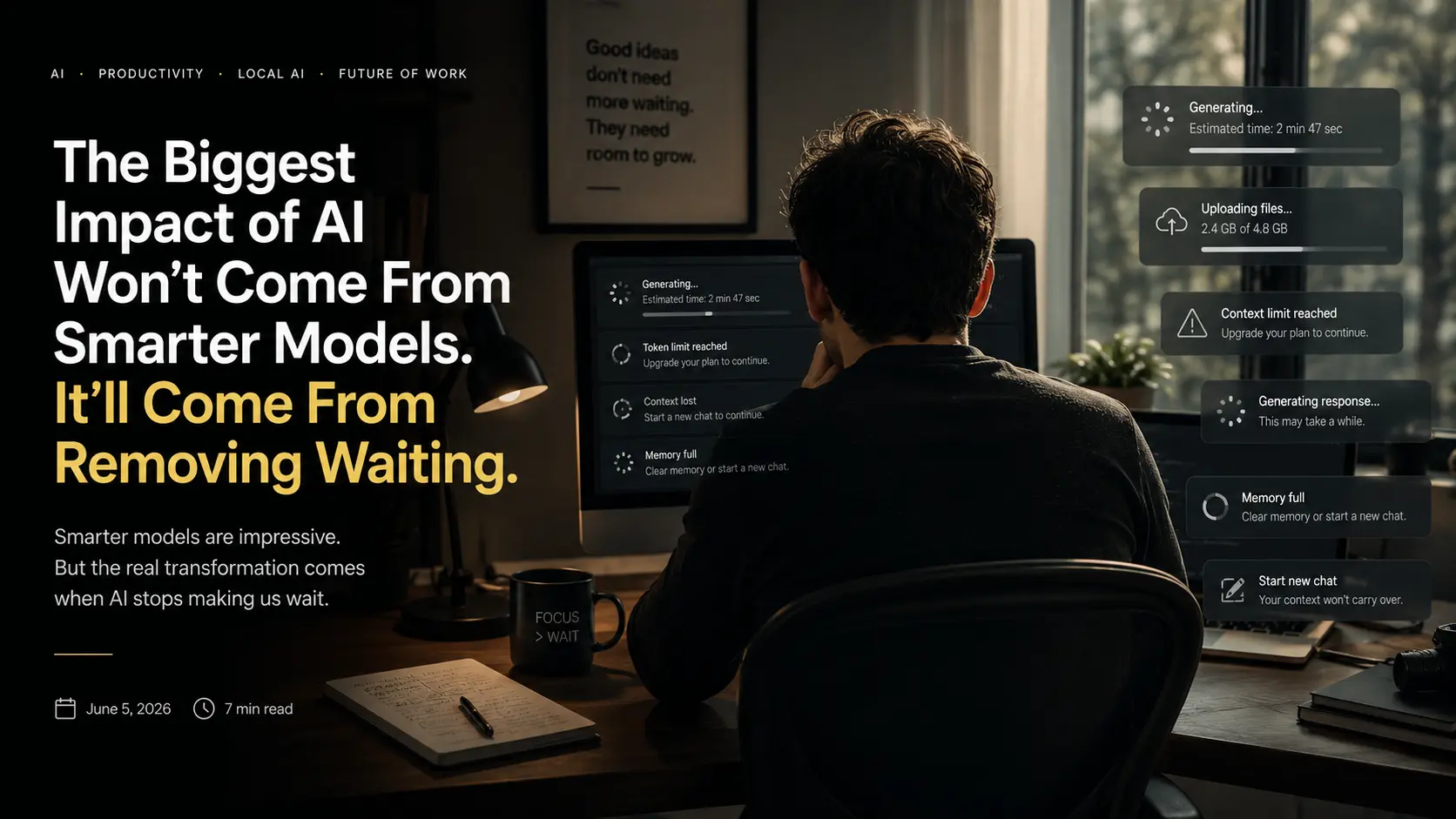
I have a theory. The biggest impact of AI won't come from smarter models. It'll come from removing waiting.
I've been thinking about this since reading about NVIDIA's RTX Spark. Not because of the hardware itself, but because of what it points toward: AI that lives next to your work instead of somewhere else entirely. That shift, when it fully arrives, will change things more than any benchmark improvement.
Here's why.
The waiting problem nobody talks about
If you're a heavy AI user, think honestly about how much of your day is spent waiting.
Waiting for generations to complete.
Waiting for uploads to finish.
Waiting because you've hit a token limit.
Waiting because the AI lost the thread of what you were building.
Waiting because you had to start a new chat and explain everything from scratch.
We don't talk about this enough. We've quietly built our entire AI workflow around these constraints. We've adapted our thinking to fit the tool. We've become part creator, part AI babysitter.
Compress this. Split that. Remove these files. Rewrite the prompt. Start over.
You're not focused on the work. You're focused on fitting the work into the AI.
Tokenmaxxing: the hidden tax on AI productivity
I've started calling this tokenmaxxing.
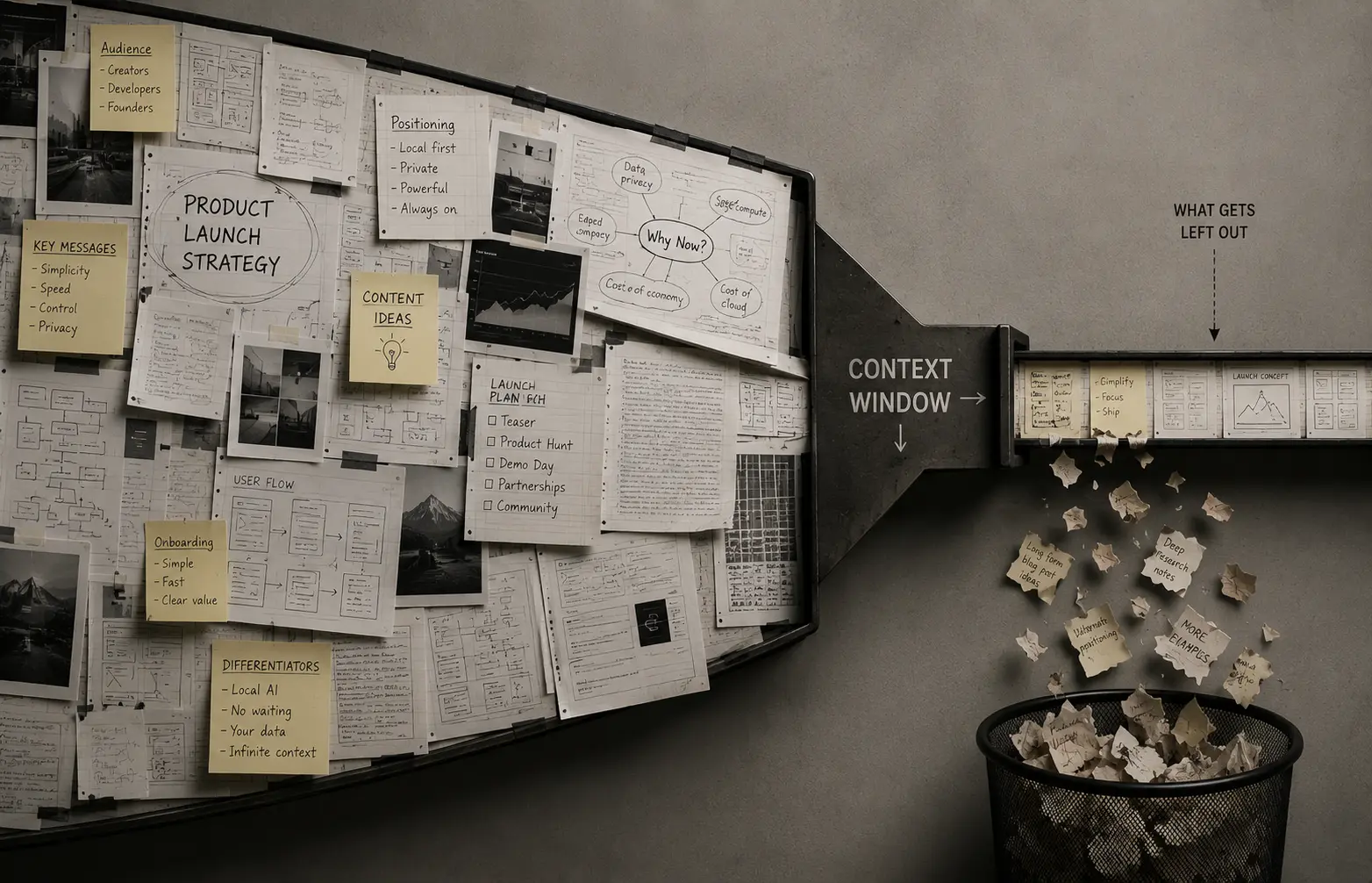
Tokenmaxxing is what you do when the constraints of an AI system start shaping your creative decisions. When you find yourself trimming context not because it's irrelevant, but because you're running out of space. When you restructure a project not to think more clearly, but to fit inside a limit. When you spend more energy managing the AI's memory than actually doing the work.
Some people call it prompt engineering. But prompt engineering sounds like a skill. Tokenmaxxing is closer to the truth: it's a workaround. A tax on every interaction.
And the more complex your work, the heavier the tax. Because ongoing projects with real depth are exactly the kind of thing context windows were never built for.
Somewhere along the way, we stopped asking the AI to help us think. We started asking it to help us survive its own limitations.
What happens when AI sits next to your work
The shift from cloud AI to local AI is not just a technical upgrade. It's a change in the relationship between you and the tool.
Right now, cloud AI is like having a brilliant assistant who gets amnesia at the end of every meeting. You re-brief them every time. You carry the context yourself. Your files, your projects, your history: none of it transfers. You start from zero on every session.
Local AI changes that. Your context is always there. Your work history is always available. The AI knows where you left off without you having to explain it again. It stops being something you log into and starts being something that runs alongside everything you do.
When you remove that friction, something shifts in how you think. You stop protecting your ideas from the overhead of re-explaining them. You start moving faster. You follow threads you would have abandoned before because starting felt too expensive.
That is not a small change. That is the tokenmaxxing tax, removed.
When generation is fast, the cost of experimentation collapses
Speed is not just a convenience. Speed changes what's possible.
Right now, generation latency shapes creative decisions in ways most people don't notice. You think of an idea, wait for the output, assess it, iterate. That cycle has a cost. Slow generation means you protect your decisions. You invest in fewer directions because each one takes time.
When generation becomes fast enough, that changes completely.
Instead of exploring five ideas, you explore five hundred.
Instead of testing three directions, you test thirty.
Instead of protecting every decision, you start following curiosity.
The bottleneck is no longer creation. Creation becomes cheap. Almost free.
Which means the bottleneck shifts somewhere else entirely.
The new bottleneck: judgment
When AI can generate almost anything, the real skill isn't making more things.
It's knowing which things are actually worth keeping.
What's worth building.
What's worth pursuing.
What's worth ignoring.
For most of creative and knowledge work, the bottleneck has always been production. Getting the thing out of your head and into the world. AI has already started moving that bottleneck. Fast, local, always-on AI will finish the job.
And when production is no longer the constraint, judgment takes its place. The ability to look at a hundred outputs and know which one is right. Not just technically correct. Not just competent. Actually right for this moment, this audience, this purpose.
That is a deeply human skill. And AI makes it more valuable, not less.
Taste is the skill nobody is training for
The most valuable people in the AI era might not be the best prompters. Or the people with the most powerful hardware.
It might be the people with the best taste.
Taste is the ability to recognize signal in an ocean of noise. To spot the one great idea inside hundreds of average ones. To know when something has soul and when something is technically impressive but emotionally empty.
I've believed this for a long time. AI just makes it more urgent.
When everyone has access to the same generation tools, the same models, the same compute, the differentiator won't be who can produce the most. It'll be who can recognize what's actually worth producing.
AI does not remove the need for taste. It exposes the lack of it.
And here's the uncomfortable part: taste is not a technical skill. You can't prompt for it. You can't fine-tune your way to it. It comes from deep exposure to great work, from strong opinions held and revised over time, from caring enough to develop real standards.
That takes years. Which means the window to build it is now, before everyone else realizes it's the thing that matters.
So what actually becomes valuable?
When AI can generate almost anything, instantly, locally, without friction: what is the truly valuable human skill?
My answer is taste. The ability to decide what's worth keeping from an endless stream of capable output.
But I'm curious what you think. Is it taste? Creativity? Judgment? Decision-making under uncertainty? Something else entirely?
We spend a lot of time talking about what AI can do. We don't spend nearly enough time asking what humans should get better at.
What's your answer?
Get the next post
New essays on AI, creative technology, and building at the edge. No spam, unsubscribe anytime.
Powered by Substack