An extended reality platform built for Emirates, the world's best airline, that changes how cabin crew train. Photorealistic Unreal Engine environments, digital twins of real aircraft, AR, VR, AI simulation, multiplayer capabilities, and Apple Vision Pro support. Available 24/7, from any device, anywhere in the world.

The Brief
Emirates is consistently rated the world's best airline, a brand built on exceptional service, rigorous standards, and a cabin crew that trains harder than almost any other in the industry. The brief was to reimagine how that training happens. Traditional methods (physical mock-ups, classroom sessions, printed manuals) were expensive, inflexible, and impossible to scale globally. Emirates and AWS wanted something better.
The Challenge
Enterprise training technology is notoriously conservative. The stakes are real. Cabin crew need to know exactly what to do in an emergency, how to operate complex service equipment, and how to represent a world-class brand in every interaction. Any training platform had to meet the standard of the training it was replacing.
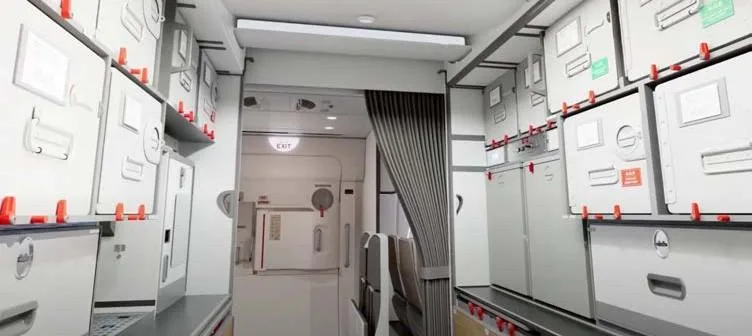
Building photorealistic digital twins of Emirates aircraft at 1:1 fidelity, accurate enough to train on, required deep collaboration with the airline's engineering and operations teams. The platform also needed to run across multiple device types, from standard computers to VR headsets to the newly released Apple Vision Pro, without sacrificing visual quality or interactivity.
And it needed to work anywhere in the world, at any time, for a cabin crew that operates across time zones and continents.
The Approach
MIRA was built on Unreal Engine, the same technology used in AAA game development and Hollywood visual effects, chosen for its photorealistic real-time rendering. The aircraft interiors were reconstructed as precise digital twins: every seat, galley, panel, and emergency system modelled with operational accuracy.
The platform delivers training across multiple modes. In VR mode, crew members step inside the cabin and complete training scenarios in full immersion, practising emergency procedures, service sequences, and passenger interactions in a space that looks and feels like the real aircraft. In AR mode, physical training environments are augmented with digital overlays, blending real-world context with virtual guidance.
AI simulation drives the adaptive learning layer. Scenarios respond to trainee performance by adjusting difficulty, surfacing relevant content, and giving real-time feedback. Multiplayer lets an entire crew cohort train together in the same virtual space and rehearse a real service as a team, without everyone being in the same physical location.
AWS provided the infrastructure backbone, so the platform could scale globally with the reliability Emirates demanded. Apple Vision Pro support was integrated as the spatial computing landscape matured.
The Output
MIRA is a fully deployed, production enterprise platform. Cabin crew around the world train on it today. The platform has changed Emirates' training operations. It reduces dependence on physical infrastructure and lets training happen on crew schedules rather than facility schedules.
Every decision on the project, from rendering fidelity to UX to infrastructure resilience, had to hold to the standard of the world's best airline.
Frequently asked questions
What is the Emirates MIRA platform?
MIRA is an extended reality training platform built for Emirates cabin crew, developed with Emirates and AWS. It replaces physical mock-ups, classroom sessions and printed manuals with photorealistic digital twins of Emirates aircraft that crew can train in from anywhere in the world, at any time.
Why was it built on Unreal Engine?
Unreal Engine is the technology behind AAA game development and Hollywood visual effects, chosen here for its capacity for photorealistic real-time rendering. Aircraft interiors were reconstructed as precise digital twins, with every seat, galley, panel and emergency system modelled to operational accuracy.
What devices does MIRA run on?
The platform runs across multiple device types, from standard computers to VR headsets to Apple Vision Pro, without sacrificing visual quality or interactivity. That range lets a cabin crew operating across time zones and continents train wherever they are.
Why did the digital twins need 1:1 fidelity?
Because the stakes are real. Cabin crew need to know exactly what to do in an emergency and how to operate complex service equipment, so the platform had to meet the standard of the training it replaced. Building at that fidelity required deep collaboration with the airline's engineering and operations teams.
Built withUnreal Engine · AR / VR · Apple Vision Pro · Digital Twin · AWS Infrastructure · AI Simulation · Multiplayer / Networking · Real-Time 3D
Xerocon AI Music Factory →
