Claude Code Runs My Creative Studio. I'm Not a Developer.

My studio is two people. We work with clients across a few continents, on real deadlines, for real money. For the past year almost everything we have delivered has passed through a coding tool called Claude Code.
I am not a developer. I have never shipped an app. I wanted to know whether someone like me can run an actual business on a tool built for programmers, so I spent a few weeks pulling my own setup apart to see what was doing the work.
Five things were doing the work. None of them are code.
The video version, with the screens. 10 min 29 sec. Watch on YouTube
- 0:00The question
- 0:26What Claude Code actually is
- 1:22One: the folder is the business
- 1:59Two: CLAUDE.md, the standing orders
- 3:57Three: memory
- 4:59Four: graphify, the map
- 6:02Five: the second brain, and skills
- 7:19What changed with Claude Fable 5.1
- 8:10A real job: this channel, this week
- 8:49What breaks
- 9:42The answer
A non-developer can run a business on Claude Code. It takes five setups, and none of them involve writing code:
- One folder holding the entire business, so the model works from a year of context instead of a pasted brief.
- A CLAUDE.md file of standing orders, read at the start of every session, kept under forty lines.
- Memory, which is what Claude Code writes about you, so Monday does not start from zero.
- A knowledge graph of the folder, so it queries a map instead of reading two hundred files.
- A wiki the model maintains, so the studio stops repeating mistakes it already made once.
What is Claude Code?
Claude Code is an agent that runs inside a folder on your computer. You open a terminal, type claude, and it can read every file in that folder, write new ones, run commands, open a browser, and report back on what it did. The same engine runs in the terminal, the desktop app, the browser and on a phone.
The name puts people off. It sounds like a tool for programmers, and every example in the documentation is a codebase. But it reads whatever is in the folder you point it at. Mine holds briefs, brand guides, client work, quotations and a website. To Claude Code those are files, the same as any repository.
It took me about a year to work out what that means in practice. These five setups are the result.
1. Put the whole business in one folder
The first setup costs nothing. One folder. Mine is called agency.
Inside it: brand, clients, leads, site, brain, tools. Every client has a folder. Every deliverable lands in it. The website deploys from it. When I ask for the carousel for the travel client, Claude Code already knows where their logo lives, which fonts they use, and what we sent them last month.
Most people who try AI and come away unimpressed are working from a chat window. They paste in a brief, get something generic back, and decide the model is overrated. The model had a paragraph to work with. Give it the folder and it has a year of decisions to work with instead.
2. CLAUDE.md: the standing orders it reads every session
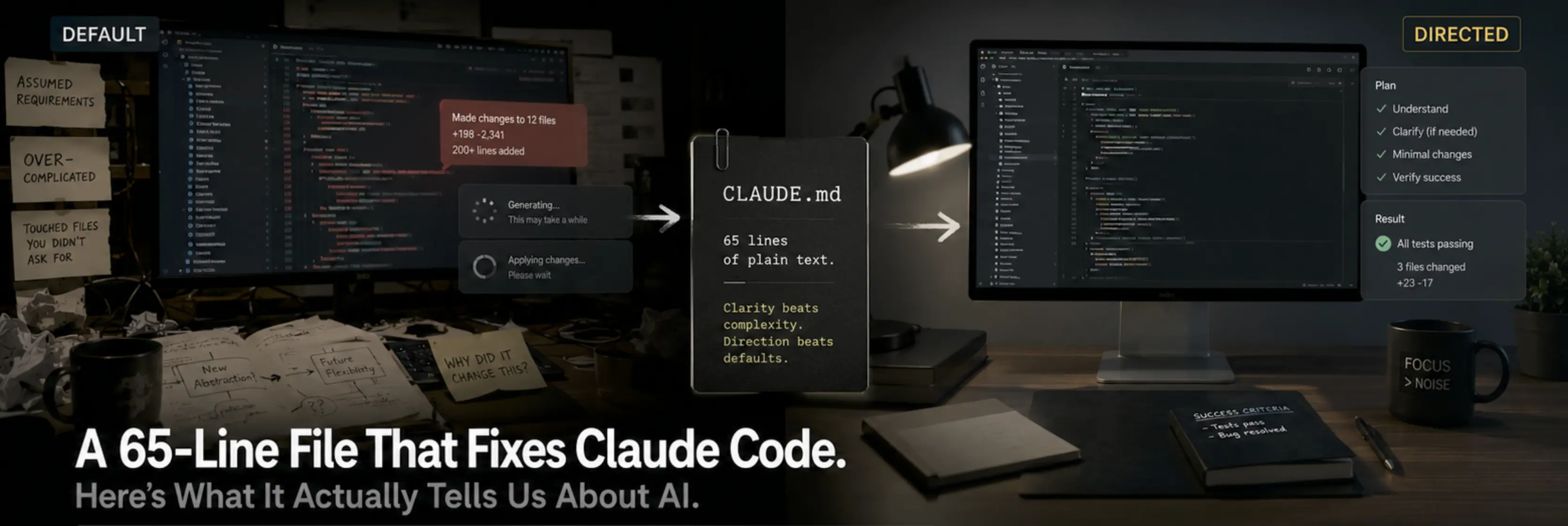
CLAUDE.md is a plain text file at the top of the folder. Claude Code reads it at the start of every session, before I have typed anything. Mine has two sections. One explains how to navigate the repo. The other explains how the studio's knowledge base works, and says in capitals never to commit anything sensitive. It runs to under forty lines.
You may have seen the headline about this file being dead. Boris Cherny, who runs Claude Code at Anthropic, told a room of founders at Y Combinator to delete their CLAUDE.md, their skills and their hooks every six months, and see what the model does without them. The internet read that as an obituary. His next sentence was the important half:
The first step is you delete. The next step is you use it.
Delete, then run it, then add back only what actually breaks. His team did this to Claude Code itself. When Opus 5 shipped they cut roughly eighty percent of its system prompt, then restored lines one at a time and measured each one. Most of the deleted lines had been compensating for mistakes the older models made. The newer model did not make them.
Six months earlier the same person said the opposite-sounding thing:
Every single time Claude makes a mistake, I don't tell it to do it differently. I tell it to write it to the CLAUDE.md.
Both hold. The file records what the model gets wrong, and each model gets less wrong than the last, so a well-maintained CLAUDE.md shrinks over time rather than growing. Anthropic's documentation gives the test in one line: for each rule, ask whether removing it would cause a mistake, and cut it if the answer is no.
What I do now: if I explain something twice, it goes in the file. Every few months I delete the file and see what survives.
3. Memory: the notes Claude Code writes about you
Claude Code keeps two kinds of memory, and confusing them is the reason people think it forgets everything. CLAUDE.md is what you write. Auto memory is what it writes.
| CLAUDE.md | Auto memory | |
|---|---|---|
| Who writes it | You | Claude Code, as you work |
| What it holds | Standing orders for the folder | One fact per file, typed by category |
| When it loads | Start of every session | Index loads at the start of every session |
| How you correct it | Edit the file | Delete the line |
I have about thirty of these notes on my machine right now. Each one holds a single fact with a type attached: who I am, corrections I have given, project decisions, where things live.
Two real ones. "Never use em dashes in Kurt's copy." And "Always show Kurt the stills before animating anything, because animation costs money." I said both of those out loud, once, months ago. They come back every session.
There is an index file, and its first two hundred lines load every time Claude Code starts. So a tool that technically begins each morning with nothing walks in holding yesterday's notebook. It is all plain text in a folder you can open, so when it remembers something wrong you fix it by deleting a line.
4. Graphify: a map of the folder instead of a search
The fourth one I did not build, and it is the reason the rest scales. Graphify is an open source tool from Graphify Labs that reads an entire folder and turns it into a graph: every file, every concept, and the relationships between them.
On my repo that comes to 2,023 nodes, 1,957 edges and 230 communities, built on my laptop with zero API calls.
It changes how Claude Code finds things. Instead of reading two hundred files looking for the answer, it queries the graph and gets back something small and exact. It is the difference between opening every drawer in the house and asking the person who knows where things are.
I wrote a hook to enforce it, a short script that fires whenever Claude Code tries to search raw files and tells it to query the graph first. It listens most of the time.
5. A second brain, and the skills that maintain it
The fifth setup is the studio's long-term memory, which is separate from Claude's. It is a wiki of thirty-odd cross-linked articles covering every client, every technique that worked, every piece of research and every process. The model maintains it. I do not.
The workflow is deliberately stupid. There is an inbox folder called raw. I drop things into it: a transcript, a client PDF, a link. Then I type one command, brain update. It reads the inbox, writes or updates the relevant articles, links them together and refreshes the index.
That command is a skill, which is a folder with instructions in it. Boris Cherny's rule of thumb is that anything you do more than once a day should become one. Mine are brain, brain add, brain update, brain lint and brain research. Five verbs cover most of my working day.
Graphify indexes the wiki too, so everything the studio has learned sits one question away. Last month a client asked for a destination reel. The brain already held the rule from the previous one: real locations only, never imagined ones. Nobody had to remember it, which is what the wiki is for.
What changed with Claude Fable 5.1
Anthropic shipped Claude Fable 5.1 a couple of weeks ago, and the pricing change lands squarely on this kind of work.
Talking to the model costs the same. But cache reads, the part that re-reads your files at every step, dropped from one dollar to twenty five cents per million tokens. Anthropic's estimate for long-running agentic work is up to around forty five percent cheaper overall. A business folder generates exactly that kind of repeated file reading all day long.
Two other things moved with it. The newer models will stay on a single task for days. And Boris Cherny said at YC that since Opus 5 they can no longer demonstrate prompt injection, meaning a web page that says "delete everything" no longer persuades it. A year ago that was a live concern.
Cheaper to leave running, and safer to leave running. That combination is what makes this practical for someone without an engineering team behind them.
What this looks like on a real job
The clearest example I have is the YouTube channel this post is built around. I set the whole thing up in a week.
In one session Claude Code pulled apart a reference video I liked, frame by frame, and wrote down its visual system. It generated the background world you see behind the panels in the video. It laid out the style frames, built the channel banner, then fixed the crop after I sent it a single screenshot of YouTube's upload tool. It wrote the description and the keywords, made the watermark, and kept a running log so the next day it knew every decision we had already made.
A year ago that was a week of work across three people. The model getting smarter is not what changed there. The waiting disappeared, which is the shift I wrote about in why the biggest impact of AI won't come from smarter models.
What Claude Code gets wrong
It is not magic, and a normal week produces a list like this one.
It asks permission constantly, which is correct behaviour and still slows you down. That hook I wrote, the one telling it to query the graph first, kept firing all week because it kept trying to search raw files anyway. It hung a headless browser for five minutes and cheerfully retried. It told me a font was installed when it was not. It quoted me a price that did not match the bill.
I caught all of those because I looked.
Boris Cherny's answer to this is the single tip I would keep if I could keep only one: give the model a way to check its own work. A test it can run. A screenshot it can compare against. A hook that says no. He puts the quality improvement from verification alone at two to three times.
So it does the work, you build the check, and you still look.
So, can a non-developer run a business on a coding tool?
Yes, and the tool being clever has little to do with it. A folder, a file of standing orders, a memory, a map, and a brain. All five are decisions about where things live and what you are tired of repeating, written down somewhere the model can read them.
Start with the folder, because it costs nothing and it changes the most. Add the CLAUDE.md when you notice yourself explaining the same thing twice. Then delete it every few months to find out how much of it the model still needs.
If you want the version with the screens and the receipts, the video is here, and there is a new one every week. If you are building something like this inside your own studio or team, tell me what you are working on.
Frequently asked questions
Do you need to be a developer to use Claude Code?
No. Claude Code is an agent that runs inside a folder on your computer. It reads the files in that folder, writes new ones, and runs commands. It does not care whether those files are code. A folder of briefs, brand guides, quotations and client work is just as readable to it as a codebase, which is why a non-developer can run day to day business operations on it.
What is a CLAUDE.md file and what should go in it?
CLAUDE.md is a plain text file at the top of your folder that Claude Code reads at the start of every session, before you type anything. Treat it as standing orders: how to navigate the folder, how your knowledge base works, and any hard rules such as never committing sensitive data. Keep it short. A useful test from Anthropic's own docs is to ask, for each rule, whether removing it would cause a mistake. If not, cut it.
Should you delete your CLAUDE.md file?
Periodically, yes. Boris Cherny, who runs Claude Code at Anthropic, told founders at Y Combinator to delete your CLAUDE.md, skills and hooks every six months, then run the model and add back only what actually breaks. His team did exactly that to Claude Code itself, deleting roughly 80 percent of its system prompt when Opus 5 shipped and restoring lines one at a time. Most of the deleted lines were fixes for mistakes newer models no longer make. The file is a record of what the model gets wrong, so it should keep shrinking.
How is Claude Code memory different from CLAUDE.md?
CLAUDE.md is what you write. Auto memory is what Claude Code writes. As you work it keeps its own notes on your machine, one fact per file, typed by category: who you are, corrections you have given, project decisions, and where things live. An index file loads at the start of each session, so the tool walks in with yesterday's notebook. It is plain text, so if it remembers something wrong you delete the line.
What is graphify and why use a knowledge graph with Claude Code?
Graphify is an open source tool from Graphify Labs that reads an entire folder and turns it into a graph of files, concepts and the relationships between them, rather than a search index. On my studio repo that is 2,023 nodes, 1,957 edges and 230 communities, built locally with zero API calls. Instead of reading two hundred files to find something, Claude Code asks the graph a question and gets back a small, exact answer.
What is a Claude Code skill?
A skill is a folder containing instructions for a task you repeat, invoked as a single command. The rule of thumb is that anything you do more than once a day should become a skill. Mine are brain, brain add, brain update, brain lint and brain research, which cover most of my working day.
What does Claude Code get wrong?
Plenty. It asks permission constantly, which is correct and also slow. It ignored a hook I wrote telling it to query the knowledge graph before searching raw files. It hung a headless browser for five minutes and kept retrying. It told me a font was installed when it was not, and quoted a price that did not match the bill. The fix is verification: give it a way to check its own work, whether that is a test it can run, a screenshot it can compare, or a hook that says no.
Did Claude Fable 5.1 make Claude Code cheaper to run?
For long running work, yes. Talking to the model costs the same, but cache reads dropped from one dollar to twenty five cents per million tokens, a 75 percent reduction. Anthropic's estimate for agentic workloads is up to around 45 percent cheaper overall. That matters because a business folder generates exactly that kind of repeated file reading all day.
Sources
- Anthropic, Claude Code documentation, including the memory and best practices pages.
- Anthropic, Introducing Claude Fable 5.1 and Claude Mythos 5.1.
- Y Combinator, Boris Cherny: We Cut 80% of Claude Code's Prompt.
- Graphify Labs, graphify on GitHub.
Get the next post
New essays on AI, creative technology, and building at the edge. No spam, unsubscribe anytime.
Powered by Substack