One Person Beat a Studio's AI Movie. How?
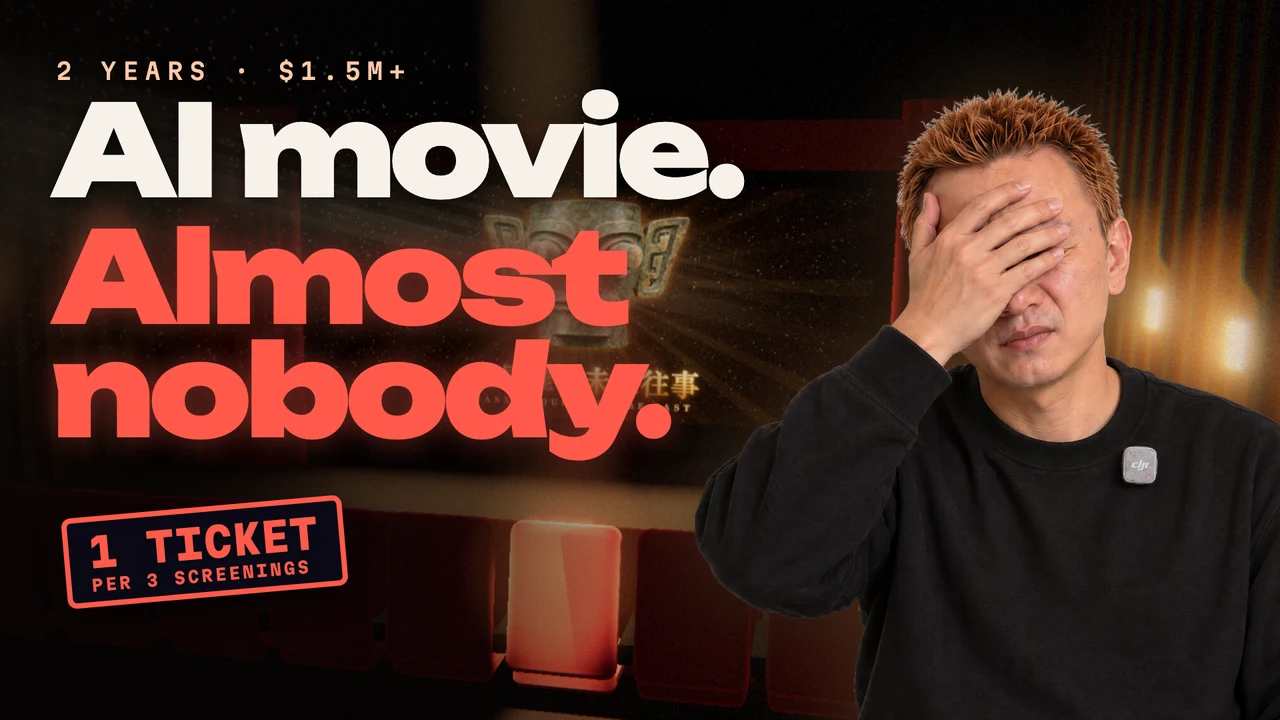
Two AI films came out within a week of each other this October, and the cheap one won by a mile. On 28 October, a creator who posts as antrofrog uploaded No Ordinary Love, a 59-second cartoon drawn to look handmade and animated with AI. Within its first 21 hours it had collected roughly 14 million views and plays on X, Threads and TikTok combined.
Five days earlier, Bona Film Group, a major Chinese studio, had released Sanxingdui: Future Past in cinemas across China. It runs 100 minutes and took the studio more than two years, and according to Bona, AI generated every image. On the Monday after it opened, it sold roughly one ticket per three screenings.
I run Original Copy Studio, which makes AI video for clients, so I have a stake in this and you should read my take with that in mind. I looked into both films, priced out a finished minute of AI animation, and then made 30 seconds of my own to see how far one person gets today. It picks up from my posts on animating a whole video in code with Claude and what AI video really costs.
I refer to the creator by his handle only. None of his frames or audio are used here or in the video; the cartoon you see in the video is our own drawing.
- Length decided it. In a 59-second clip, a face that drifts once looks like a style choice. Over 100 minutes in a cinema, audiences complained about stiff mouths and an art style that kept changing.
- It was free. The short played for nothing in feeds people were already scrolling. A 2026 US survey found people roughly twice as interested in fully AI-made short-form content as in long-form.
- A finished minute of AI animation costs about $180 to $620 in generation fees. I worked that out from Seedance 2.5's prices and one filmmaker's ratio of 13 seconds generated for each second used. Studio 2D animation runs about $1,500 to $20,000 a minute.
- My 30-second test cost 90 cents. Seventeen images and 47 minutes, animated in code with no video model. My studio's price to a client would be around SGD 1,500.
- Ownership is the weak spot. In the US, prompting alone doesn't make you the author, the tools keep a perpetual licence to what you make, and unlicensed music is the likeliest reason a short gets pulled.
The video version. 9 min 8 sec. Watch on YouTube
- 0:00One AI short vs a studio's AI movie
- 0:39No Ordinary Love: the viral AI short
- 2:10Sanxingdui: Future Past, an AI movie in cinemas
- 3:29Why the AI short worked
- 5:10AI animation cost: my 30-second test
- 7:14AI copyright law: who owns an AI short?
- 8:20Will AI replace animators? My take
What is No Ordinary Love, the viral AI short?
No Ordinary Love is a 59-second animated romance made with AI tools and posted by antrofrog on 28 October 2026. George spends the film trying to catch Gina's eye, and his chance finally comes with the rain, because he's the one carrying an umbrella. It's styled to look like traditional hand-drawn 2D animation.
He listed his tools in a reply under the post:
| Tool | What he credits it for |
|---|---|
| Midjourney 8.2 | George's character design |
| Krea 3 | Gina's character design. Krea had opened the beta on 15 October, less than two weeks before. |
| Seedance 2.5, from ByteDance | The animation |
| Krea | Where he says the film was made |
His bio calls him an artist with zero skills who relies on AI instead. The X account was 53 days old when the short went up, and when someone asked how long it took him, his answer was a couple of days.
The replies pulled in opposite directions. One illustrator wrote that she'd assumed a person drew it until she learned AI made it. The quote post with the most likes that I could find took the opposite view, mocking his bio, and passed 30,000 likes within a day.
The soundtrack is Sade's No Ordinary Love, released in 1992. When a viewer asked about it, he confirmed the artist and linked Sade's official video. Whether he has a licence to use it, he hasn't said.
He seemed ready for a claim. Within four hours of posting, he added, with a smiley, that he expected some studio to claim the short and have it removed. It had happened to him before. His previous hit, Smooth Operator, passed 24 million views on X and was then disabled after a copyright report on 1 October. He says Cartoon Saloon filed it, over a background child on screen for one second who "supposedly" resembled one of the studio's characters. I couldn't find any statement from Cartoon Saloon. He didn't file a counter-notice, saying it would mean handing over his personal details and risking a lawsuit, and on 1 November he posted a remake.
The numbers kept climbing after the first day. By 3 November the three posts of No Ordinary Love had about 34 million views and plays between them, and his next short, Englishman in New York, had passed 35 million views on X alone.
What is Sanxingdui: Future Past?
Sanxingdui: Future Past (三星堆:未来往事) is a 100-minute science-fiction film from Bona Film Group, built around the ancient bronzes of Sanxingdui, and Bona says AI generated every image in it. It opened in Chinese cinemas on 23 October 2026, with ShengShu's Vidu model credited as its chief technical support. Caixin called it China's first AI movie in cinemas, although The Reunion Journey, an AI-animated feature, had opened there in February.
| Sanxingdui: Future Past | Figure |
|---|---|
| Time in production | More than two years, according to Bona |
| Base images generated | More than 1.2 million |
| Full versions of the film | More than 100 |
| Team | 70 to 100 people, depending on the report |
| Budget | More than 10 million yuan, about $1.5 million. Its producer put a live-action version at 300 million yuan or more. |
| Opening day | Nearly 11,000 screenings |
| Opening weekend | About one viewer per screening. China's average in the first half of 2026 was nearly six. |
| Monday, 26 October | About one ticket sold per three screenings. Bona's shares fell 10% that day. |
| First six days | About 1.37 million yuan ($206,000). Bona's cut of that is roughly $71,000. |
| Up to 2 November | About 1.69 million yuan ($253,000), and still showing |
A lot of the criticism was about faces and continuity: mouths that barely move, tears that look like eye drops, a drawing style that changes between scenes, and characters wearing the same clothes in the snow. Bona's team described one scene the AI never got right. A woman bends down to hug a boy, and every attempt came out with their arms melted together, so they restaged the moment in the edit. Around half the shots from the spring trailers were replaced before release.
Why did the AI short work when the AI movie didn't?
The short only had to hold together for a minute, it cost nothing to watch, and it leaned on things people already love. Those three, as I see it, did most of the work.
1. Length hides the flaws
Every problem Bona described gets worse with running time. One wobble in a 59-second clip passes for character. The same wobble every few minutes for 100 minutes, on a screen several metres wide, gets noticed and talked about. People spot far more on a cinema screen than they ever would on a phone.
2. Free, and already in your feed
Nobody had to decide to watch No Ordinary Love. It turned up, at no cost, in feeds people were scrolling anyway. Sanxingdui cost about 30 yuan and an evening.
Alvarez & Marsal surveyed 1,968 US adults between October 2025 and January 2026 and found roughly twice the interest in fully AI short-form content as in long-form. Between 50 and 60% were open to AI-made social videos or ads, but only 25% to an AI-generated TV series.
Chinese viewers also have no shortage of the short version. Of the roughly 128,000 micro-dramas released in China in the first quarter of 2026, about 122,000 were made with AI, more than 95%, according to the China Netcasting Services Association. Plenty of them stream free on phones, and some viewers wondered why anyone would buy a cinema ticket for the same thing.
3. It borrowed what people already love
This one doesn't flatter AI. The short rides on a hand-drawn look, a gentle old-fashioned courtship and a famous 1992 song. Bona had to create an original cast and keep every face consistent for 100 minutes, which, in my view, is where today's video models are weakest.
Rough pictures alone don't sink a film, either. Niu Lai, a hand-drawn cartoon from a mother-and-son team, opened on 5 August and took about 7,700 yuan in its first ten days. People online joked that it looked worse than a beginner's AI animation. Then it went viral, and Maoyan now shows it past 60 million yuan, more than 40 times Sanxingdui's first six days. Audiences don't reject a film just for looking rough.
How much does AI animation cost per minute?
By my estimate, a finished minute of AI animation costs about $180 to $620 in generation fees on Seedance 2.5. That figure leaves out subscriptions, music and the biggest cost of all, the time of whoever is making it.
Two numbers go into it. The first is the price per second. BytePlus ModelArk, ByteDance's own API, lists Seedance 2.5 at $0.231 a second for 720p video, and the reseller Kie.ai charges $0.79 a second for 1080p. You're billed for every take that generates, including the ones you bin.
The second is the hit rate. The most detailed public breakdown I found comes from Charlie Driscoll, who made Tales of Grimwicke, a 22-minute AI fantasy film, with Seedance 2.5 in four weeks. He generated 847 takes, more than five hours of footage, and used 127 of them, for about $4,500 in generation fees. That's roughly 13 seconds generated for each second that made the cut.
Multiply it out: 60 seconds × 13 × $0.231 comes to about $180, and 60 × 13 × $0.79 comes to about $616.
| Cost per finished minute | Amount | Based on |
|---|---|---|
| AI generation, Seedance 2.5 | About $180 to $620 | My estimate, generation fees only |
| Studio 2D animation | About $1,500 to $20,000 | Vidico's published price tiers |
| Flow (2024), the Oscar-winning indie feature | About $43,000 | A reported budget of about €3.5 million for 85 minutes |
| Inside Out 2 | About $2.1 million | A reported $200 million budget for 96 minutes |
That comparison makes AI look better than it is, because every other row pays for people: animators, directors, voice actors and composers.
My test: 30 seconds of animation for 90 cents
Thirty seconds on Seedance would have cost me somewhere between $20 and $90, depending on whether it took three takes per shot or thirteen. Before spending that, I tried a cheaper route.
The scene, Last Bus, is two strangers on a night bus in the rain who keep glancing at each other across the aisle. Claude, the AI I code with, did the production. It generated two character sheets with an image model, GPT Image 2.5, then backgrounds, keyframes and pose and blink variations. Every image prompt ended with the same style line, which kept all 17 frames looking like one film:
hand-drawn 2D cel animation still, clean ink lines, flat cel colours with soft shading, painted backgrounds, warm night palette of amber and teal, gentle film grain. No text, no logos.
Then it animated those stills in code with HyperFrames, an HTML-to-video framework, with no video model involved.
| Last Bus | Result |
|---|---|
| Images | 17 generated, 16 used. The reject was a blink that closed the wrong character's eyes. |
| Cost | $0.90 for the images |
| Video model | None. Animated in code. |
| Time | 47 minutes in total, from generating the first image to rendering the final file. About half of that went on waiting for my approvals. |
| What moves | Rain, splashes, the bus, reflections, passing lights, blinks and glances |
| What doesn't | Nobody walks across the frame |
| My studio's price for the same 30 seconds | Around SGD 1,500 |
A head turn gave the most trouble. In the first render, the woman briefly had two faces as she glanced across the aisle. Claude fixed it with a solid mask over the whole head.
Strictly speaking, what I made is a motion comic rather than character animation. Still, one person made it in under an hour for less than a dollar.
Who owns an AI-generated short?
Less than you might think, and it cuts both ways. A studio can only get his short removed if it holds the rights to some part of it, but he may have little power to stop other people copying it.
| Question | Short answer |
|---|---|
| Can a studio get it taken down? | Only if it holds the rights to something inside it, such as the music, a character or a piece of footage. The notice has to come from the copyright owner or someone authorised to act for them. |
| What if the claim is wrong? | On X, a counter-notice can get the post restored roughly ten business days later if the claimant doesn't go to court. Your contact details are passed to the claimant. Anyone who knowingly files a false claim can be liable for damages under US law. |
| What is his biggest risk? | The music. It's Sade's song, so whoever owns the recording or the composition is the likeliest to object. |
| Does he own the images? | In the US, not through prompts alone, according to the Copyright Office's January 2025 report. In 2023 it registered the text and layout of Zarya of the Dawn, a comic illustrated with Midjourney, but not the images. |
| What about China? | A Chinese court has upheld copyright in an AI image before. In 2025, though, a creator lost a case at the Beijing Internet Court because they couldn't produce their original prompts and generation records. |
| Do the AI tools get rights too? | Yes. Midjourney's and Krea's terms both give the company a perpetual licence to what you generate. |
He's already feeling it. Two days after posting, he said hundreds of reuploads had appeared with barely any credit to him. When a critic told him no copyright law protects AI content, he replied that he was talking about morals, not laws.
Will AI replace animators?
For a minute of video in a feed, one person with AI tools can already do a studio's job, and No Ordinary Love shows it. For a 100-minute film people buy tickets to see, nobody I can find has managed it, whether the crew is one person or a hundred.
It does change what my studio sells. Frames are the cheap part now. Clients pay for the story, the eye to throw away most of what gets generated (Driscoll kept fewer than one take in six), and a person who's accountable when something goes wrong. Qu Jixiaojiang, a producer on Sanxingdui, told Xinhua that tasks can be handed to AI, but judgement and responsibility can't be outsourced along with them. I agree with him.
If you make AI shorts, two habits will save you trouble later:
- Save all your prompts and takes. The Beijing case was lost for want of exactly those records.
- License your music before you post. It's the part of a short most likely to get it pulled.
Frequently asked questions
What is No Ordinary Love, the AI short by antrofrog?
No Ordinary Love is a 59-second animated romance posted on 28 October 2026 by a creator who goes by antrofrog. He credits Midjourney 8.2 and Krea 3 for the character designs, and says he animated it with ByteDance's Seedance 2.5. It drew roughly 14 million views and plays on X, Threads and TikTok combined in its first 21 hours.
How did Sanxingdui: Future Past do at the box office?
Badly. Bona Film Group's 100-minute AI film opened in China on 23 October 2026 on a budget Bona puts above 10 million yuan, about $1.5 million. It took about 1.37 million yuan ($206,000) in its first six days, and on its first Monday it sold roughly one ticket per three screenings.
Why did the AI short go viral when the AI movie flopped?
In my view, three things. At 59 seconds, small glitches pass as style, while 100 minutes on a cinema screen exposes every one. The short was free in feeds people were already scrolling, while the film needed a ticket. And the short borrowed a hand-drawn look and a 1992 Sade song, while the film had to hold an original cast steady.
How much does AI animation cost per minute?
By my estimate, about $180 to $620 per finished minute in generation fees with Seedance 2.5, at $0.231 to $0.79 a second and roughly 13 seconds generated for each second kept. That excludes subscriptions, music and labour. Studio 2D animation costs about $1,500 to $20,000 a finished minute.
Can you copyright an AI-generated animation?
In the US, not through prompts alone. The Copyright Office said so in January 2025, and in 2023 it registered the text and layout of Zarya of the Dawn but not its Midjourney images. Midjourney and Krea also keep a perpetual licence to what you generate. Keep your prompts and generation records: a creator lost a 2025 case in Beijing without them.
Will AI replace animators?
Not for long-form work yet. One person with AI tools can now make a minute of animation that holds its own against a studio in a social feed, but I haven't found a 100-minute AI film that audiences have paid to see in any numbers. Clients still pay for the story, the judgement to discard most takes, and someone accountable for the result.
Sources
I checked these up to 3 November 2026. antrofrog has said he plans to delete and remake his videos, so links to his posts may stop working.
- The short: No Ordinary Love on X, His tool credits, Krea 3 beta, He confirms it's Sade, Waiting for a claim, Smooth Operator taken down, Why he didn't counter it
- The movie: Xinhua, Economic Observer via ifeng, Sanxingdui on Maoyan, Dengta data via Sohu Tech, Shidai Zhoubao via NetEase, Guangming on the national average, Xinzhoukan via Sina, Caixin, The Reunion Journey on Maoyan
- Why the short worked: Alvarez & Marsal, Lights, Camera, AI, China Youth Daily on micro-dramas, Niu Lai on Maoyan, NetEase on Niu Lai, Cartoon Brew on Niu Lai
- Costs: BytePlus ModelArk prices, Kie.ai prices, Charlie Driscoll's breakdown, Tales of Grimwicke, Vidico on animation costs, Film Stories on Flow's budget, The Numbers on Inside Out 2
- Who owns it: X copyright policy, US Copyright Office, January 2025, Zarya of the Dawn decision, National Law Review on the Beijing case, Midjourney terms, Krea terms
Get the next post
New writing on AI and creative technology. No spam, unsubscribe anytime.
Delivered by Substack
Keep reading
Creative technologist and AI Forward Deployed Creative at Original Copy Studio.