AI Video Subscription vs API: What It Really Costs
My studio recently delivered a campaign for a travel agency: four presenter videos, four destination reels, roughly eighty images. Around 275 seconds of finished AI video.
Billed through a pay-per-use API, it came to $101. Priced against Higgsfield's published rates, the identical output works out at roughly $95.
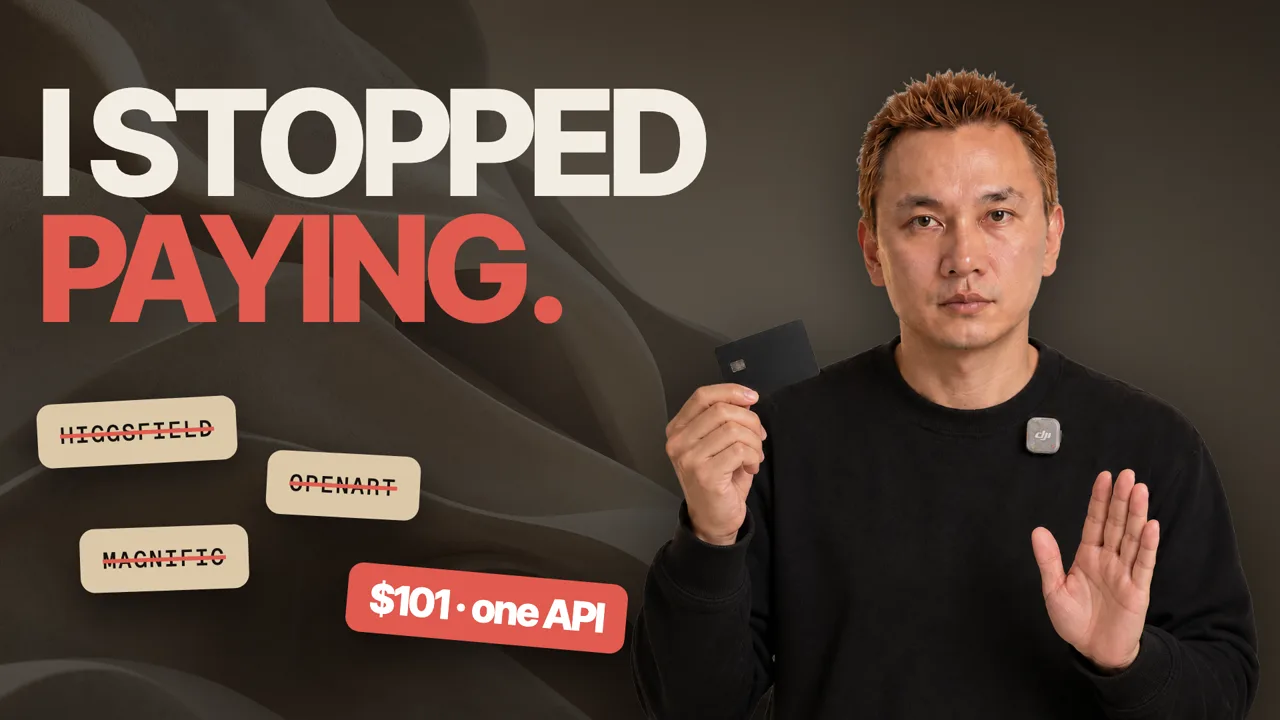
Which raises an awkward question, because I cancelled Higgsfield, OpenArt and Magnific. If the platform is six dollars cheaper, what exactly was I objecting to?
I started this assuming the platforms mark the clips up. They don't. The answer turned out to be more useful than that, and it is not about the clip at all.
The video version, with the receipts on screen. 10 min 58 sec. Watch on YouTube
- 0:00The question
- 0:33What you're actually buying
- 1:53The receipt
- 3:15Six things the credit hides
- 5:48The other door
- 8:16What breaks
- 9:08Where the subscription wins
- 10:03The verdict
- Per clip, the platforms are competitive. Ten seconds of Seedance 2.0 costs about $2.15 on Higgsfield and $3.03 through fal, the best-known developer API.
- The subscription is the product. Roughly 70% of Higgsfield's revenue is subscriptions rather than credit top-ups.
- Six mechanics sit between the sticker price and what you pay, starting with credits that expire after thirty days.
- Going direct takes about ten minutes to set up and does not require you to write code.
- Some people should stay. The break-even is around 45 clips a month, every month, using every credit.
Every figure below carries a September 2026 date. Verify the current rate yourself before committing to any plan.
What you are actually buying
Higgsfield, OpenArt, Magnific, Midjourney and Runway are, structurally, the same business. You get an interface, somewhere to type, and a monthly balance to spend against.
None of them built the models. Underneath, they are renting what everyone else rents: Seedance from ByteDance, Kling, Veo from Google, Nano Banana, Seedream. The product being sold is the interface, and the interface is lucrative. Higgsfield reached roughly $700M of annualised revenue inside sixteen months. Midjourney turns over half a billion a year with about sixty people and no outside investment.
Credits make the comparison hard on purpose, because each platform prices its own unit differently. As of September 2026 a single credit was worth $0.03 to $0.08 on Higgsfield, $0.012 in Kling's own app, $0.003 on OpenArt, $0.0007 on Magnific and $0.005 on poyo. The number on the button is meaningless until you convert it.
So I converted one. Here is ten seconds of Seedance 2.0 at 720p with audio, priced four ways:
| Route | Cost for one 10s clip |
|---|---|
| Higgsfield (44 credits) | about $2.15 |
| fal | $3.03 |
| poyo | $2.00 |
| WaveSpeed, fast endpoint | $1.00 |
The subscription platform undercuts the best-known developer API and holds its own against the discount resellers. Whatever I had been paying for, a marked-up clip was not it.
The receipt
Because the API logs every task, the campaign itemises exactly:
| Deliverable | Model | Output | Cost |
|---|---|---|---|
| 4 presenter videos | Seedance 2.0, 1080p, lip-synced | 160 seconds | $72.00 |
| 2 destination reels | Seedance 2.0, 720p | 60 seconds | $12.00 |
| 2 destination reels | Kling | 55 seconds | $3.58 |
| Stills | GPT Image 2 | about 78 images | about $14.00 |
| Total | 275 seconds of video | about $101 |
One line in that table matters more than the total. We produced presenter clips on Kling as well, and the client turned them down, so the priciest option is what ended up shipping. Model selection is not really yours to make. It belongs to whoever approves the work, usually after comparing both.
Now price the same job on the platforms, and the shape of the problem appears.
Higgsfield works out at about $95 of credits, except that nobody sells $95 of credits. Starter cannot hold that much. Plus would take two months to accumulate. Ultra covers it inside one month for $129, at which point a thousand credits expire unused.
Magnific needs roughly 274,000 credits for this job. Its entry plan provides 240,000 for an entire year. One campaign would consume more than the annual allowance.
OpenArt lands somewhere in the eighties at sticker price, but reaching that rate means being on the $240 per month plan.
The per-clip cost really is comparable everywhere. What differs is the month you are obliged to buy around it.
Six things the credit price hides
| Mechanic | What it means | What it costs you |
|---|---|---|
| 1. Expiry | Subscription credits reset at the end of the billing month on Higgsfield, Runway and OpenArt. Magnific runs a year instead. | Use 40% of a $49 plan and your true rate is 2.5x the sticker |
| 2. Failures | Higgsfield deducts credits when a generation runs, irrespective of whether the result is usable. Kling's own consumer app works the same way, and users there report peak-hour failure rates between 40% and 60%. | Discarded takes are billed in full. Notably, Kling's developer API waives charges on failed tasks. |
| 3. "Unlimited" | A slower queue, restricted to a single concurrent job, usable only through the browser. The terms specify human use and forbid automation. | Route anything through a script or agent tool and it draws on ordinary credits instead |
| 4. The tier | Plan rungs run 200, 1,000 then 3,000 credits, with 1080p and the full model line-up on the upper ones. | The resolution your client wants sits on a plan you did not want |
| 5. Defaults | Runway users reported in August 2026 that the interface steered toward the most expensive model. | One agent feature reportedly consumed 9,000 credits in twenty minutes unprompted |
| 6. IP filtering | A second filter sits above whatever the model already enforces. Higgsfield's help pages list sports leagues, recognisable characters, the styles of living artists, and any branded logo appearing as the subject. | Enforced platform-wide, and holding the rights yourself does not exempt you |
That last one caught me off guard, and it is the most expensive to discover late. The presenters in my campaign wear the client's own logo on their shirts. To a platform filter, that is a branded product used as a subject, and it is blocked. Going direct, only the model's own filter applies, and the clip generated without incident.
To be precise, because this is easy to misread: none of that is a copyright loophole. Recognisable people and franchise characters get refused by the models themselves, on any route, and that is correct. The additional platform layer simply sets a higher bar than the law does, which makes sense once you remember who receives the legal letter.
Stack those six together and the $700M makes sense. About 70% of it is subscription revenue. The clip is sold close to cost; the month is the product.
Going direct takes about ten minutes
This is the part people assume requires an engineer. It does not, and I am not one. Three steps, identical whether you use poyo, fal or WaveSpeed.
Step one: get a key. Sign up, find the API keys screen, generate one. It goes into a single-line .env file in your project directory. Nothing else is confidential, and the key never appears in a conversation, because the coding tool loads it from disk.
Step two: hand over the documentation. Leave the provider's docs open in a tab and tell Claude Code to read them. Then state the outcome plainly: this model, this resolution, this prompt, save the finished file here.
Step three: let it build the thing. A script gets written and executed. The underlying pattern never varies between providers. A request goes out and comes back with a reference number, that reference gets checked repeatedly until the job reports complete, then the file is retrieved. Swapping to a different provider is a one-line edit.
The setup is a ten-minute exercise you do once. From then on, six clips is a request rather than an afternoon at a keyboard. I ran exactly that live: six vertical five-second clips on Seedance 2.0 via poyo, itemised, $6.00.
There is work this route makes possible that a browser simply cannot reach. Our presenter clips needed lip-sync against a pre-recorded voice track, and each had to continue from the closing frame of its predecessor. Sequencing like that is inherently a script. Inside these platforms it is either missing from the interface or prohibited by the unlimited tier's terms.
On resellers: I use poyo because for my model mix it is the cheapest I have found, running 30 to 45% below fal on Seedance. It is not universally cheapest, and WaveSpeed wins on Seedance Fast and on Kling. Do not take my word for it, or anyone's. Three tabs, one line each, thirty seconds.
Worth naming the subscription I did keep: Claude on the Max plan. It is the most expensive thing I pay for and it runs every project in the studio, which is the context for how Claude Code came to run the whole operation.
What breaks when you go direct
Something always does, and these are the four that have bitten me.
Resellers drop models. A model you have built a pipeline around can vanish from the price list and the script calling it simply stops. So the model list gets reviewed alongside the prices.
Nothing is archived for you. A platform stores your history on a neat gallery page. Direct access returns links instead, and links have a habit of going dead. The discipline is to pull every file down on completion and let your own directory be the record.
Failure billing varies. poyo does not charge for blocked prompts. Whether a given provider charges for a generation that dies halfway through differs, and that detail lives in the terms rather than on the button.
Pricing is unstable. Higgsfield restructured its plans multiple times over 2026 alone. Treat the numbers in this post as a snapshot dated September 2026, with a short shelf life.
When the subscription is the right answer
Cancelling is not the universal conclusion, and the break-even is calculable.
At Higgsfield Plus on annual billing, $39 buys 1,000 credits, which is about 45 Seedance clips at 720p. The same 45 clips through poyo cost roughly $45. So if you genuinely produce 45 clips every month and consume the entire allowance, the plan wins, and it is considerably simpler than anything described above.
Three further cases stand up. Upscaling work still points to Magnific, whose upscaler remains the strongest and whose credits run for a year rather than thirty days. Teams that need seats, a shared space and a document finance will accept are buying something genuine. And browser-based image iteration all day suits a slower unrestricted queue well.
Below that threshold the maths turns. Twenty clips against an allowance built for forty-five works out at $1.95 each, for output that costs a dollar. Months where you make nothing cost nothing on the other route.
The verdict
The clip was never what I was objecting to, because the clip was never the expensive part. What I stopped buying was the billing period around it: an allowance that expired on schedule, invoices for footage the client had already rejected, a tier bought solely to reach 1080p, and time spent in a queue.
For a studio my size it comes down to one line. Rent the model, skip the month, and let the coding tool be the interface.
And if you happen to build one of these platforms, none of the above is news to you. The clip runs at cost and you know it. Charge me for what I consume rather than for the calendar.
Frequently asked questions
Is Higgsfield worth paying for?
It depends entirely on volume. Higgsfield Plus at annual billing gives 1,000 credits for $39, which covers roughly 45 Seedance clips at 720p; the same clips bought directly run about $45. So if you reliably produce 45 clips every month and exhaust the allowance, the plan wins and is far simpler to operate. Produce twenty in a given month and your effective rate is $1.95 per clip for output that costs about a dollar.
Do Higgsfield credits expire?
Yes. Subscription credits reset at the close of each billing month on Higgsfield, and Runway and OpenArt work the same way. Magnific is the outlier, running its credits over a year. Expiry is the single largest gap between sticker price and real cost: consuming 40% of a $49 allowance puts your true rate at roughly two and a half times the advertised figure.
Why do AI video platforms charge for generations you reject?
Because billing happens when the generation runs, not when you accept the output. Higgsfield deducts at that point regardless of whether the result is usable, and Kling's consumer app operates identically, with users reporting peak-hour failure rates of 40% to 60%. Developer APIs often differ: Kling's own API does not bill for failed tasks.
What does 'unlimited' actually mean on an AI video plan?
Generally a slower queue rather than uncapped usage. In practice it means one job running at a time, browser only, with terms specifying human use and prohibiting automation. Anything driven by a script, command line or agent tool falls outside it and consumes ordinary credits, so the unlimited tier is unlimited only for as long as you sit there clicking.
Why was my own client's logo blocked?
Platforms apply a content filter on top of whatever the model already enforces, and branded logos appearing as the subject of a generation are commonly on that list alongside sports leagues, recognisable characters and the styles of living artists. It is enforced across the whole platform and owning the rights does not exempt you. Working directly against the model, only the model's own filter applies.
Can you use a video model API without being a developer?
Yes, and the setup is roughly ten minutes. You generate an API key and save it to a local file, point a coding tool such as Claude Code at the provider's documentation, then describe the result you want in plain language. Every one of these services follows the same request-poll-download pattern underneath, so moving between providers is a one-line change.
Is fal or poyo cheaper for AI video?
Neither wins across the board. For the model mix in this campaign poyo ran 30% to 45% below fal on Seedance, but WaveSpeed was cheaper on Seedance Fast and on Kling. Taking one clip specification and pricing it across three tabs takes about thirty seconds and is worth doing before committing to any provider.
How much does ten seconds of AI video cost?
For Seedance 2.0 at 720p with audio in September 2026: about $2.15 on Higgsfield, $3.03 through fal, $2.00 through poyo and $1.00 on WaveSpeed's fast endpoint. The spread between the cheapest and dearest is threefold, and notably the subscription platform is not the expensive option.
What goes wrong when you stop using a platform?
Four things, in my experience. Resellers withdraw models, which breaks any pipeline calling them. Nothing is archived for you, and the links returned can expire, so files must be pulled down immediately. Whether a provider bills for a generation that fails partway through varies and lives in the terms. And pricing moves frequently enough that any figure needs rechecking.
What is the actual difference between platform and API pricing?
Very little at the level of an individual clip, which is the surprise. The difference is structural: platforms sell a billing period, with credits that expire, tiers gating resolution and models, failed takes billed anyway, and an extra content filter. Roughly 70% of Higgsfield's revenue comes from subscriptions rather than credit purchases, which tells you which half of the business matters.
Sources
Every price in this piece was taken from the provider's own published pages in September 2026 and is dated accordingly. These figures move often, so verify the current line before committing.
- Higgsfield pricing and credit table, and the help centre on unlimited models and IP blocks
- OpenArt pricing and Magnific pricing
- poyo, fal, Seedance 2.0 and WaveSpeed
- Sacra, Higgsfield revenue estimate, July 2026
Get the next post
New essays on AI, creative technology, and building at the edge. No spam, unsubscribe anytime.
Powered by Substack