Jensen Huang Could Join Elon Musk Tomorrow. He Probably Won't.
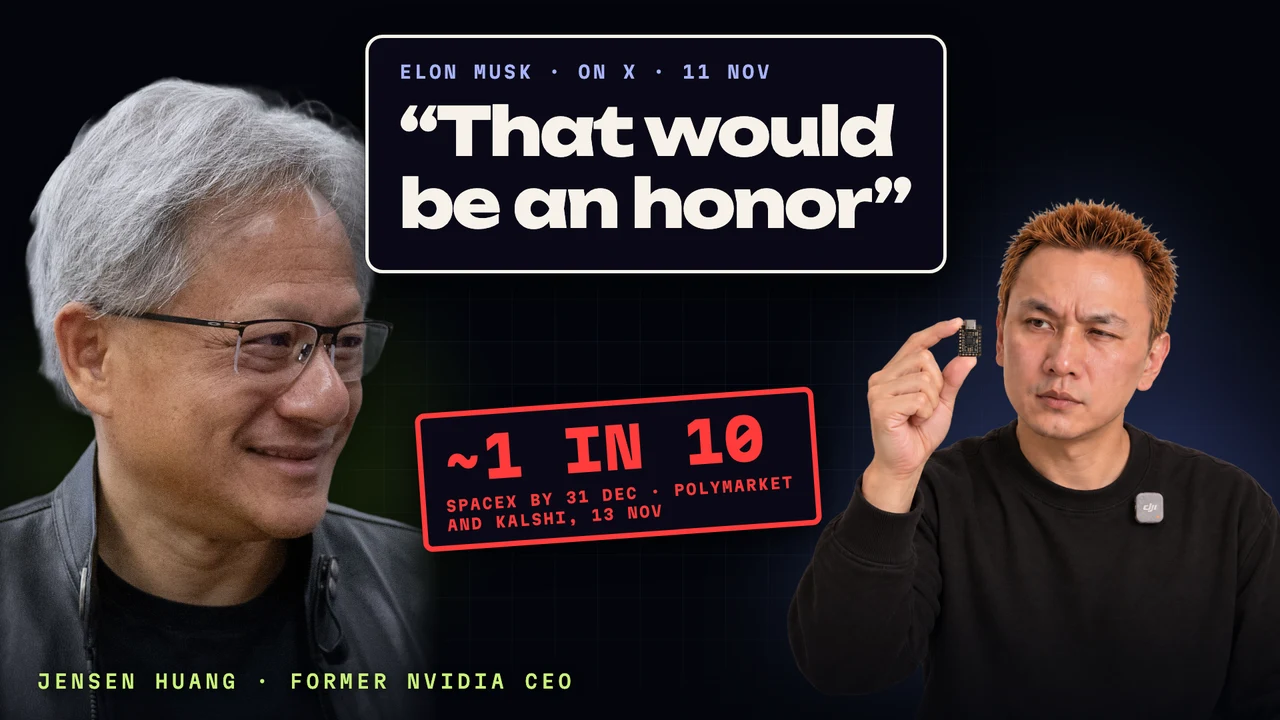
On the evening of 11 November, US Eastern time, ZeroHedge posted four words on X: "Elon please hire Jensen". Elon Musk answered within a couple of hours: "That would be an honor." By the following morning Nvidia had told the market that Jensen Huang was no longer its chief executive. He co-founded the company in 1993 and had run it ever since.
Musk was probably joking, but the option is real. Huang can't be held to a non-compete in California, he has no employment contract to break, and he still owns roughly $145 billion of Nvidia shares. Legally, he could start somewhere new next week. I wanted to know where he's actually likely to go, what a Musk move would do to OpenAI and Anthropic, and whether the AI boom has a bubble problem now that the person behind Nvidia's spending has gone.
A disclosure before I start: I build my work on Claude, made by Anthropic, and Anthropic is one of the companies in this story. None of this is investment advice. I've kept the scandal to a few lines, all of them attributed. For the wider race between the AI labs, see the race to build AGI, explained. My last piece was on the Binance hack.
- Nvidia's board accepted Huang's resignation on Wednesday 11 November and announced it on Thursday the 12th. The filing gives no reason. Bloomberg and the WSJ say he was forced out. Colette Kress, the finance chief, is interim CEO.
- The scandal week cost Nvidia about $494 billion, not $2 trillion. The share price is down 30.5% from its 6 October record, but most of that fall came before Huang's 8 November email to staff.
- California law leaves him free to work for anyone, rivals included. What actually holds him back is a stack of open investigations and the fact that his fortune is still mostly Nvidia stock.
- Polymarket puts the chance he joins any company this year at under 10%. My pick is that he backs startups or a fund with his own money once the investigations close.
- A move to Musk is the least likely and the most disruptive option. SpaceX depends on Nvidia chips, Nvidia owns about $21 billion of SpaceX, and Anthropic rents a whole SpaceX data centre.
The video version. 10 min 27 sec. Watch on YouTube
- 0:00Jensen Huang resigns: what happens next?
- 0:48Accepted Wednesday, announced Thursday
- 1:46Nvidia stock drop: not two trillion
- 2:54Free on paper: no non-compete in California
- 4:20Four doors: Jensen Huang's next move
- 5:48Elon Musk and Jensen Huang: "That would be an honor"
- 8:02AI bubble or not? The banker left
- 9:51Nvidia without Jensen Huang: watch the chequebook
Why did Jensen Huang resign as Nvidia CEO?
Nvidia hasn't given a reason. Its 8-K filing says only that the board accepted Huang's resignation on 11 November with immediate effect, and it lists no separation terms. Bloomberg and the WSJ both describe it as an ouster.
The background is an allegation, and I'll keep it short. The New York Times reported on 29 October that, according to US intelligence officials, China's Ministry of State Security had recruited a senior figure at Megaspeed, a Nvidia customer based in Singapore, and that she had been in a relationship with Huang. Nobody has been charged with anything. China's foreign ministry has called the claims unsubstantiated. The US attorney general says no conclusions have been reached about who she is.
| Date (2026) | What happened |
|---|---|
| 6 October | Nvidia's share price closes at a record $239.24. |
| 29 October | The New York Times publishes its report on Megaspeed and Huang. |
| 5 November | Nvidia falls 9.3% as tech stocks slide on AI spending fears and the midterms. |
| 8 November | Huang emails staff, admits he was unfaithful to his wife, and promises full cooperation with an independent board investigation. |
| 11 November | The board accepts his resignation. That evening, US time, Musk replies "That would be an honor" on X. |
| 12 November | Nvidia announces the change. Kress becomes interim CEO and stays CFO. Harvey Jones, a director since 1993, becomes the company's first board chair. |
| 17 November | Nvidia's third-quarter results, its first since Huang left. |
Musk's reply went up before Nvidia had told anyone Huang was leaving, so it can't be read as a response to the resignation. It also named no job and no company, and nobody has reported any talks.
How much has Nvidia stock dropped?
From its record close on 6 October to its close on 12 November, Nvidia fell 30.5%, from $239.24 to $166.19. That wiped about $1.76 trillion off its market value. You'll see "$2 trillion" in headlines, which comes from measuring against the intraday peak.
Neither number belongs to the scandal. Count from 6 November, the last trading day before Huang's email, and the stock lost about 11%, or roughly $494 billion. The other $1.27 trillion or so went in the month before, mostly on worries about AI spending, including that 9.3% drop on 5 November.
| Period | Nvidia's fall | Value lost |
|---|---|---|
| 6 Oct to 12 Nov (whole slide) | -30.5% | About $1.76 trillion |
| 6 Oct to 6 Nov (before his email) | About -22% | About $1.27 trillion |
| 6 Nov to 12 Nov (scandal week) | -11% | About $494 billion |
| 12 Nov alone | -4.3% at the close, after opening 13% down | n/a |
Where did the money go?
On resignation day Nvidia opened 13% lower, hit -14.35% at the low, then recovered to finish 4.3% down. The money stayed in chips and moved to Nvidia's competitors. AMD closed the week to Thursday up about 30%, against a gain of about 3% for the S&P 500.
The companies that took a beating were the ones Nvidia has backed with its own money. CoreWeave, a cloud provider Nvidia has invested $2 billion in, fell nearly 12% that day. I come back to why in the bubble section. Again, none of this is a suggestion to buy or sell anything.
Can Jensen Huang legally join a rival?
Yes. California treats employee non-compete clauses as void under section 16600 of its Business and Professions Code, and since January 2024 it has been unlawful even to write one into an employment contract. A separate 2024 law, SB 699, lets the employee sue and recover legal fees if an employer tries to enforce one. Nvidia is based in California, so the rule covers him.
Nvidia also had nothing else to hold him with. Its 2026 proxy statement says it doesn't give its named executives employment agreements or severance terms. Bloomberg reports he walks away from about $108 million of unvested stock, which is around 0.07% of a stake worth roughly $145 billion.
The one legal limit that still applies is trade secrets. He can work anywhere, but he can't take Nvidia's confidential information with him.
So what's stopping him?
Two things hold him back, and neither of them is a contract.
The first is the list of open matters with his name near them:
- He has agreed to closed-door testimony before Congress ahead of Thanksgiving, according to Representative Brian Mast. The date was still being negotiated on 13 November.
- Nvidia's board has hired Wachtell Lipton and the former prosecutor Joon H. Kim to run its review.
- The Justice Department's National Security Division is investigating Megaspeed.
- A shareholder class action lists him as a defendant.
None of these is a charge. A law professor told CNN on 12 November that the legal danger lies in being truthful with investigators rather than in the affair itself. Still, I can't see a company that holds classified contracts, needs export licences or sells into China hiring him while all of that is open.
The second is his money. He owns about 3.58% of Nvidia. Most of it sits in trusts where his wife is a co-trustee. Trust experts told CNBC that neither of them can probably sell those shares without the other. Whatever he does next, a weaker Nvidia makes him poorer, which rules out anything that looks like a direct attack on it.
What is Jensen Huang's next move?
I see four realistic options. Here they are with the prediction-market prices from 13 November where a market exists. These are thinly traded markets, so treat the numbers as a mood rather than a forecast.
| Option | What the markets say | My read |
|---|---|---|
| 1. Step back | Polymarket: about 90% that he joins no company before the end of 2026 | Most likely in the short term. Nothing public for months while the testimony, review and lawsuit run. |
| 2. His own fund or startups | No market | My pick for where he lands. CNBC estimates about $12 billion of his stock sits in his own name, outside the trusts. |
| 3. A rival such as AMD | No market | Unlikely while a national security investigation sits next to his exit. |
| 4. Back to Nvidia | Polymarket: 5% by end of 2026, 29% by end of 2027 | Too high, in my view, though it's the one door besides his own fund that suits both his money and his ambition. |
| Musk and SpaceX | Polymarket and Kalshi: roughly 1 in 10 by 31 December | The least likely, for the reasons below. |
Investing his own money is the cleanest route. A fund needs nobody's sign-off, avoids security reviews, and doesn't have to compete with the company that holds most of his wealth. There's a recent template: Pat Gelsinger left Intel in December 2024 and became a general partner at the venture firm Playground Global the following March.
AMD is the obvious rival on paper. Huang started his career there as a microprocessor designer, and Lisa Su, who runs AMD, is family: she's his first cousin once removed. People have switched to a direct competitor quickly before: Mark Hurd left HP in August 2010 and was co-president of Oracle by early September. Hurd's exit didn't come with a national security probe attached, though, and any chipmaker that relies on export licences would think hard about that.
A return to Nvidia has famous precedents in Steve Jobs at Apple in 1997, Bob Iger at Disney in 2022 and Sam Altman at OpenAI in 2023. Each of those needed a company in trouble or a board that reversed itself. Nvidia has just installed a new chair and an interim CEO, and nobody has reported a staff revolt.
Would Jensen Huang work for Elon Musk?
On paper the fit is strong. SpaceX absorbed xAI in February 2026 and went public in June. Musk told analysts on the company's first earnings call, "We've decided to build exclusively on Nvidia." SpaceX has taken on $40 billion of debt to buy GPUs, and Nvidia is one of its larger shareholders with a stake worth about $21 billion. Musk is also planning Terafab, his own chip factory with Tesla and SpaceX, which is the kind of project the founder of Nvidia could plausibly run.
The same links are what make it awkward. SpaceX builds spy satellites for the National Reconnaissance Office under a classified contract worth $1.8 billion, and Senator Kevin Cramer has already said Huang is vulnerable to extortion. A senior role there would mean a security clearance review at the worst possible moment. He would also be negotiating to buy Nvidia chips while his own fortune depends on Nvidia's price.
What would it mean for OpenAI and Anthropic?
This part is a what-if. Nobody has reported any talks.
Start with OpenAI. CNBC describes Huang as the person who decided who got Nvidia's GPUs, and when. If he ended up working for Musk, who has been feuding publicly with Sam Altman for years, OpenAI would be uneasy. Its signed contracts with Nvidia stay in force whoever runs the company, including the August deal for up to $105 billion of support for its Ohio data centre. I'd still expect OpenAI to lean more on AMD and Broadcom, which have agreed to supply it with 6 and 10 gigawatts of chips respectively.
Anthropic's position is stranger. Since May 2026 it has rented all of Colossus 1, SpaceX's data centre of more than 220,000 Nvidia GPUs. Nvidia, separately, agreed in November 2025 to invest up to $10 billion in Anthropic. A Musk move would put Huang inside Anthropic's landlord while his old company remained its investor. Anthropic also uses Google's TPUs and Amazon's Trainium chips, so it relies less on Nvidia than most labs.
For everyone else, the bigger worry is whether Nvidia would stay neutral. In June 2024 CNBC reported that Musk had thousands of Nvidia AI chips meant for Tesla sent to X and xAI first. With Nvidia's founder beside him, I'd expect Google, Meta and the other big buyers to speed up work on their own chips and buy more from AMD.
Is AI a bubble without Jensen Huang?
An AI bubble would mean prices and spending running well ahead of the profits that are supposed to pay for them, the way telecom equipment ran ahead of internet demand in 2000. Nvidia gets compared with Cisco, which was briefly the most valuable company in the world in March 2000 and lost most of its value over the next two years. On profits, the comparison doesn't hold up well.
| Nvidia, November 2026 | Cisco, March 2000 | |
|---|---|---|
| Price to expected earnings | About 12 to 14 times next year's | About 131 times |
| Latest reported quarter | $96.2 billion revenue (reported August), up 106% on a year earlier | n/a |
| Next quarter's own forecast | About $108 billion, results due 17 November | n/a |
The argument for a bubble is about debt. Amazon, Alphabet, Microsoft and Meta expect to spend roughly $730 billion between them this year, mostly on chips and data centres. In the third quarter, Alphabet and Meta both spent more cash than their businesses generated. Morgan Stanley counts $466 billion of AI-related borrowing up to September.
Nvidia is part of that borrowing. Reuters adds up about $164.5 billion of financial commitments, including the Ohio guarantee and more than $50 billion in leases and capacity guarantees, much of it to the same companies that buy its chips. That's why I think the firms Nvidia has funded fell harder on resignation day while its competitors rose. Investors were pricing the risk that the money stops.
Who signs the cheques now?
Colette Kress, Nvidia's finance chief, is now its interim CEO as well. The Information reported that she had resisted a $250 billion credit guarantee discussed for OpenAI in July. When Nvidia signed in August, the figure was up to $105 billion, less than half. The report doesn't say her objection caused the cut, but it tells you how the person now running Nvidia thinks about lending.
My view is that this isn't 2000 again. The largest companies in the trade make real profits, and for each dollar of profit, Nvidia is priced at roughly a tenth of Cisco's 2000 level. If there is a bubble, it's at the edges, in the younger cloud providers and AI labs funded by debt, part of which came from Nvidia. With Huang gone, the question for those companies is whether Kress keeps lending on the same terms.
What to watch next
- 17 November: Nvidia's results. The first earnings call without Huang. Watch whether the company sticks to its forecast of about $108 billion and what Kress says about its commitments to customers.
- Huang's testimony to Congress. It will be behind closed doors, but it's the first time he'll answer questions since his 8 November email.
- The board review. Until Wachtell's findings are out, I'd treat any "Huang joins X" headline with suspicion.
- March 2027: GTC. Nvidia's developer conference in San Jose, where Huang gave the keynote for years. Whoever gives it in 2027 will be the new face of the company.
I'll keep following this until Huang talks publicly. Facts in this post were checked up to 13 November 2026, before Nvidia's results.
Frequently asked questions
Why did Jensen Huang resign from Nvidia?
Nvidia hasn't said. Its filing says only that his resignation was accepted on 11 November 2026, effective at once. Bloomberg and the WSJ say he was pushed out, following a New York Times report on 29 October about alleged links between Huang and a senior figure at Megaspeed, a Nvidia customer based in Singapore. Those are allegations, and nobody has been charged.
Who is running Nvidia now?
Colette Kress, Nvidia's chief financial officer, has taken over as interim CEO while staying on as CFO. Harvey Jones, a director since 1993, has become the company's first board chair.
Did Elon Musk offer Jensen Huang a job?
No. On the evening of 11 November, US time, Musk answered "That would be an honor" to a ZeroHedge post saying "Elon please hire Jensen". The reply came before Nvidia announced the resignation, named no company or role, and no talks have been reported.
Can Jensen Huang work for a competitor?
Yes. California voids employee non-compete clauses, has made it unlawful to include one in a contract since 2024, and lets employees recover legal fees if an employer tries to enforce one. Nvidia also gives its top executives no employment contracts. He still can't take Nvidia's trade secrets with him.
How much did Nvidia stock drop?
Nvidia fell 30.5% from its record close on 6 October 2026 to 12 November, about $1.76 trillion. The scandal week itself, from the 6 November close to the 12 November close, cost about 11%, or roughly $494 billion. On 12 November the shares opened 13% lower and closed 4.3% lower.
What will Jensen Huang do next?
Nobody knows yet. On 13 November Polymarket gave about a 90% chance that he joins no company before the end of 2026, and 29% that he returns to Nvidia by the end of 2027. Congressional testimony, the board review and a class action are still open, so a long pause looks most likely, followed perhaps by investing his own money.
Is AI a bubble without Jensen Huang?
On profits, Nvidia looks nothing like Cisco in 2000. It trades at about 12 to 14 times next year's expected earnings, against about 131 times for Cisco in March 2000. The risk sits in debt: Morgan Stanley counts $466 billion of AI-related debt as of September 2026, and Reuters counts about $164.5 billion of Nvidia commitments, much of it to its own customers.
When does Nvidia report its first results without Jensen Huang?
On 17 November 2026. Nvidia has guided to about $108 billion of revenue for the quarter.
Sources
The allegations are reported, not proven, and nobody has been charged. Prediction-market odds are from 13 November and come from thinly traded markets. Facts checked up to 13 November 2026.
- The exit: Nvidia's 8-K, 12 Nov, Huang's email to staff, 8 Nov, The New York Times, 29 Oct
- The share price: Nvidia's closing prices, NBC News on the 5 Nov sell-off, CNBC live, 12 Nov
- The rules: Willkie on California's non-compete laws, Nvidia's 2026 proxy, Bloomberg on the $108M, Engadget on the testimony
- The options: Seeking Alpha on the prediction markets
- The Musk what-if: Musk's reply on X, 11 Nov, Moneywise on SpaceX and Nvidia, Reuters via CNBC on SpaceX's spy satellites, 2024, CNBC on what his exit means for AI, CoinDesk on Anthropic and Colossus 1
- The bubble question: Benzinga on forward P/E, IntuitionLabs on Cisco in 2000, I/O Fund on AI debt, Reuters on Nvidia's commitments, Fortune on Kress and the $250B guarantee
Cover photo of Jensen Huang: Peter Dasilva, © European Union, CC BY 4.0, via Wikimedia Commons.
Get the next post
New writing on AI and creative technology. No spam, unsubscribe anytime.
Delivered by Substack
Keep reading

Creative technologist and AI Forward Deployed Creative at Original Copy Studio.