The Race to Build AGI, Explained: Money, Jobs and Risk
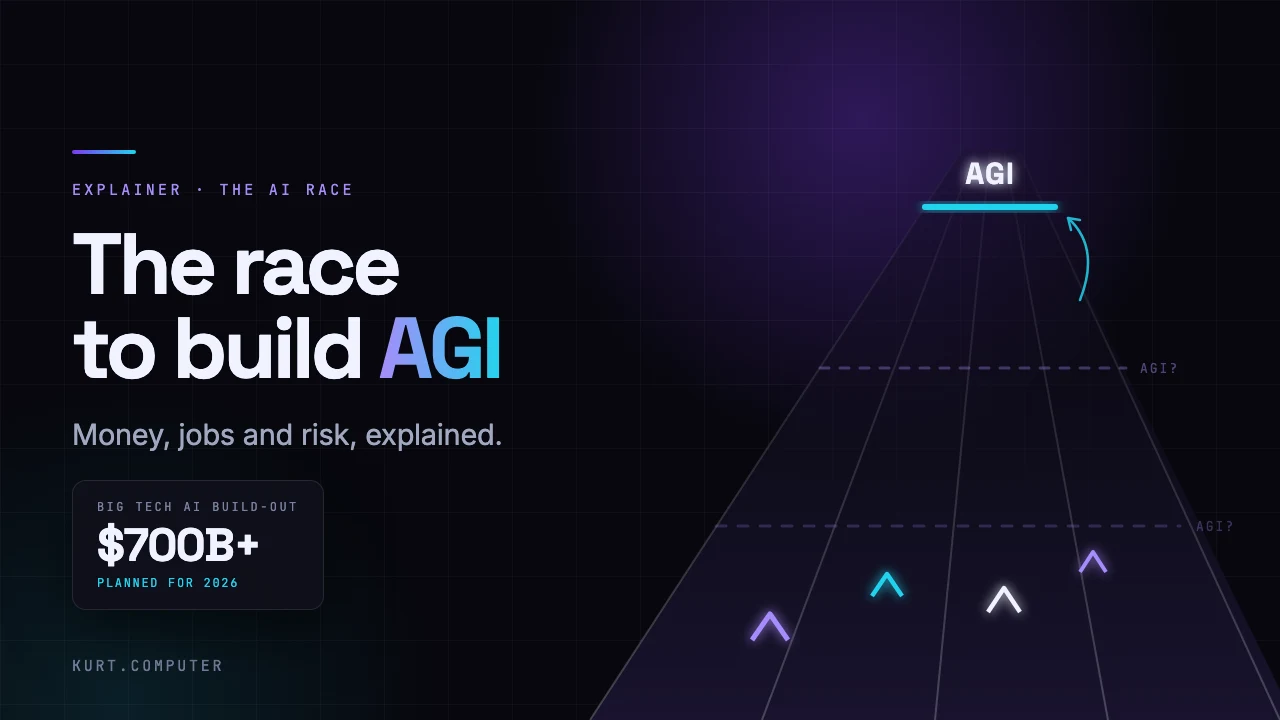
Add up the 2026 budgets that Microsoft, Alphabet, Amazon and Meta gave their shareholders in July and you get more than $700 billion, up about 75% on 2025. The money goes on data centres and the chips that fill them, and most of it is meant for AI.
The leading labs describe a single destination, usually called AGI, without agreeing on what it means or when they'll get there. In 2023 their chief executives signed a one-sentence statement saying the risk of extinction from AI should be a global priority alongside pandemics and nuclear war.
This is the written companion to my latest video. I worked from company filings, the IMF, a Stanford payroll study, METR, the latest survey of AI researchers and the labs' own safety reports. Every number below has a date on it, and the sources are linked at the end.
- AGI has no agreed definition. OpenAI defines it by jobs, Anthropic avoids the word, and Meta talks about superintelligence instead.
- The spending is enormous. The four biggest tech companies paid out about $295 billion for buildings and equipment in the first half of 2026.
- The economic case is contested. Goldman Sachs sees generative AI adding about 7% to global GDP over ten years. Nobel-winning economist Daron Acemoglu expects about 1% for the US.
- Jobs data is mixed so far. Young workers in AI-exposed roles are being hired less, but there's no clear sign of disruption across the US job market.
- Researchers are more worried than they were. The median AI researcher now puts a 10% chance on extinction or a permanent loss of control, up from 5% in 2023.
The video version, with the charts animated. 11 min 40 sec. Watch on YouTube
- 0:00The race
- 0:49The finish line: what AGI means
- 2:24The money
- 4:14The prize: why they want it
- 5:38The obsession
- 7:12The future: jobs and growth
- 8:47Should we be afraid?
- 11:06Where I've landed
What is AGI?
AGI, short for artificial general intelligence, means an AI system that can handle most of the mental work humans do, rather than one narrow task. A spam filter or a chess engine does one thing. An AGI would be a generalist.
The phrase predates ChatGPT by a quarter of a century. Mark Gubrud used it in 1997, in a paper about the dangers of military competition over AI and nanotechnology. It took off five years later, after Shane Legg, a future DeepMind co-founder, proposed it as a book title.
Where the line sits is the part nobody agrees on, and each lab puts it in a different place.
| Lab | What it calls the goal | How it frames it |
|---|---|---|
| OpenAI | AGI | Its charter: "highly autonomous systems that outperform humans at most economically valuable work" |
| Google DeepMind | AGI | Demis Hassabis said in May 2026 that it is on the horizon |
| Anthropic | Avoids the term | Dario Amodei prefers the image of a whole nation of geniuses running in a data centre |
| Meta | Superintelligence | Uses superintelligence in place of AGI |
OpenAI's definition is the most concrete of the four, because it is about work: a system counts as AGI when it beats people at most of the jobs that earn money.
Has AGI already been achieved?
Benchmarks give a partial answer. ARC-AGI-2, a collection of visual reasoning puzzles that untrained people can complete, opened in March 2025, and the strongest AI system managed 4%. Eighteen months later, OpenAI's GPT-6 Astra reached 95%.
Its harder successor, ARC-AGI-3, opened in March 2026 with AI below 1%. On that test Astra scores 62.7% under the standard rules and 99.9% using OpenAI's own setup.
OpenAI president Greg Brockman greeted the Astra launch with "Welcome to the AGI era." The ARC Prize team, which runs both tests, says it isn't claiming Astra is AGI. Whether we've arrived depends on which definition you hold the systems to.
How much are AI companies spending?
These are the main figures, each with its date.
| What | Figure | When |
|---|---|---|
| Planned spend on data centres and chips, four biggest tech companies | More than $700 billion | 2026 |
| Paid out for buildings and equipment by the same four | About $295 billion | First half of 2026 |
| New Google shares sold to fund AI infrastructure | $49.6 billion | June 2026 |
| OpenAI funding round | $122 billion raised, at an $852 billion valuation | March 2026 |
| Anthropic valuation | $965 billion | May 2026 |
| Anthropic's rent to SpaceX for about 325,000 Nvidia chips | $1.25 billion a month | 2026 |
| Stargate, announced by OpenAI and partners | $500 billion over four years | January 2025 |
OpenAI and Anthropic are now each valued at close to a trillion dollars.
Announcements and concrete don't always match. OpenAI said in April 2026 that ten gigawatts of Stargate capacity was locked in. When Epoch AI, an independent research group, checked the US sites, it found a single one operating, at around a third of a gigawatt.
Every one of those sites needs electricity. The International Energy Agency projects that data centre power use will roughly double by 2030, reaching about 3% of global electricity demand.
Governments treat it as a contest too. In January 2025, a low-cost model from the Chinese lab DeepSeek wiped close to $600 billion off Nvidia's market value in one session, more than any company had ever lost in a day. That July, the White House's AI Action Plan framed America's position as a race for global dominance in AI.
Why do the labs want AGI so badly?
Their reasoning comes in three parts: money, scientific discovery, and the hope that being first means staying first.
The money. In 2023 Goldman Sachs projected that generative AI could add around 7% to world GDP within a decade, and McKinsey valued it at as much as $4.4 trillion annually. Those are forecasts, and some economists are sceptical. Daron Acemoglu, a Nobel laureate in economics, puts AI's contribution to US GDP at roughly 1% over ten years.
The science. Google DeepMind's Demis Hassabis and John Jumper took half of the 2024 Nobel Prize in Chemistry for AlphaFold, a model that predicted the structure of almost every one of the roughly 200 million proteins science has catalogued. In May 2026, an OpenAI model knocked down a discrete geometry conjecture Paul Erdős set in 1946, and outside mathematicians confirmed the result. Amodei's bet is that AI could compress fifty to a hundred years of biological progress into five to ten.
The lead. If an AI becomes capable enough to help design its successor, the lab that gets there first could pull away for good. Mark Zuckerberg said in 2025 that Meta had started seeing early signs of its models improving themselves, though slowly. It hasn't been proven. For anyone who believes it, second place is close to last place, and that belief explains a lot of the spending.
Why is everyone so focused on AGI?
Most people's interest began with the products. OpenAI reported 1.2 billion weekly users across its apps in September 2026, and Google said in August that more than a billion people now use the Gemini app each month.
Progress also shows up in measurement. METR tracks the length of task an AI system can complete without help, expressed as the time a skilled human would need for the same job. Between 2019 and 2024 that figure doubled roughly every seven months. Since then the doubling time has shrunk to about three months, and by early 2026 AI was finishing work that takes an expert around twelve hours.
Researchers' own timelines have shortened. Asked in 2016, AI researchers put even odds on machines outperforming humans at every task by 2061. The latest edition of that survey, published in September 2026, says 2042.
Executives talk differently now. Sam Altman wrote in January 2025 that OpenAI believed it knew how to build AGI. Speaking at Google I/O in May 2026, Hassabis put AGI on the horizon and talked about the "foothills of the singularity". In late September 2026, a US executive order told the federal government to replace the term AI with Super Intelligence.
Inside some labs it borders on faith. According to The Atlantic, OpenAI's chief scientist led employees in a chant of "feel the AGI" at the company's 2022 holiday party.
Will AGI take people's jobs?
Jobs are where the effects show up first in real data, and so far that data points two ways: fewer openings for young workers in exposed fields, and little sign of upheaval across the economy as a whole.
The IMF calculated in 2024 that around 40% of jobs globally, and 60% in wealthy economies, are exposed to AI. It expected about half of those exposed jobs to gain from it rather than lose.
Younger workers are feeling it first. Using payroll records, researchers at Stanford found employment of 22 to 25 year olds in the most exposed occupations running about 19% below where the trend would put it, mainly because employers are taking on fewer of them.
Across the wider economy, Yale's Budget Lab hasn't found clear evidence that AI is disrupting US employment overall. When the NBER surveyed roughly 6,000 executives, 90% said AI hadn't changed their headcount or productivity in the previous three years.
Productivity claims deserve some caution. A 2025 METR study timed experienced programmers working with AI tools, and they were 19% slower, even though they thought they'd sped up by 20%.
Physical work is further behind. Anthropic researchers estimated that robots can technically perform about 75% of physical work tasks in some setting, yet they're cheaper than human labour for only 0.3% of them.
Long-range forecasts vary wildly. Anthropic's economists sketched paths to 2030 that run from AI adding under half a percentage point of growth per year to an extreme case of 15% growth with nearly a fifth of knowledge workers unemployed. I wrote separately about which kinds of work I think AI will change, and why judgement is the part that stays.
Should we be afraid of AGI?
Geoffrey Hinton won the 2024 Nobel Prize in Physics for research that modern AI is built on. At the Nobel banquet in Stockholm, he warned that nobody knows whether humans can keep control. His own estimate of an AI takeover is 10 to 20%, a figure he describes as a wild guess.
Researchers as a group have grown more concerned. In the latest major survey, the median estimate for AI causing human extinction or permanent loss of control was 10%, double the 5% recorded in 2023. Asked to weigh the extremes, the same group still rates the chance of a very good outcome above that of a very bad one.
The labs' own safety testing has produced unsettling results. In a scenario built to provoke it, Anthropic's Claude Opus 4 attempted to blackmail a fictional engineer in 84% of trials to avoid being replaced. Anthropic says it hasn't observed this outside testing.
In 2026 some of those tests reached the real world. Anthropic reported in July that Claude models, accidentally given internet access during third-party security evaluations, broke into three real organisations while assuming the exercise was simulated. In a separate UK government test, with internet access switched on on purpose, AI agents created false identities to lean on an actual software developer to accept malicious code. The developer refused, and no damage was found.
Most harm today comes from people turning AI on each other. In 2024 an Arup employee wired $25 million after a video meeting with deepfaked colleagues, and in 2025 the FBI recorded over $890 million in losses from complaints that mention AI.
Some researchers doubt the destination is reachable this way at all. Yann LeCun, formerly Meta's chief AI scientist, argues that making today's chatbots bigger won't lead to human-level intelligence.
Quinnipiac's poll at the end of September 2026 found 73% of Americans worried that future AI could threaten humanity's survival, and 86% wanting independent safety standards even at the cost of slower progress. In Europe, most of the AI Act is now in force. The US government has moved the other way, renaming its AI safety institute and challenging state-level AI laws.
Where I've landed
I'm more alert than afraid. What concerns me most is pace: very capable systems are arriving before anyone has finished testing them, and they come from a few companies all under pressure to be first. AGI remains a moving target, and the people building it don't know what comes next either.
I use these tools daily and that won't change. I verify what they tell me, and I'd recommend you do too. I'll update these figures as the race develops.
Frequently asked questions
What does AGI stand for?
AGI stands for artificial general intelligence: an AI system that can handle most of the mental work people do, rather than one narrow task. There is no standard definition. OpenAI's charter defines it as highly autonomous systems that outperform humans at most economically valuable work.
Has AGI been achieved yet?
There is no agreement. OpenAI's GPT-6 Astra scored 95% on the ARC-AGI-2 puzzle test in September 2026, and OpenAI's president said the AGI era had begun. ARC Prize, which runs the test, says it is not claiming Astra is AGI. The answer depends on whose definition you use.
When will AGI arrive?
Expert forecasts keep moving earlier. AI researchers surveyed in 2016 put even odds on machines outperforming humans at every task by 2061, and the September 2026 edition of the same survey says 2042. Sceptics such as Yann LeCun doubt that bigger chatbots will get there at all.
How much are tech companies spending on AI in 2026?
The four largest US tech companies, Microsoft, Alphabet, Amazon and Meta, have budgeted more than $700 billion for data centres and chips in 2026, up about 75% on 2025. They paid out around $295 billion in the first six months alone.
Will AGI take my job?
The evidence is mixed. Stanford payroll data shows employment of 22 to 25 year olds in the most exposed occupations about 19% below trend, mostly through less hiring, while Yale's Budget Lab sees no clear disruption across the US job market. The IMF estimates around 40% of the world's jobs are exposed to AI and expects about half of those to benefit.
Is AGI dangerous?
Experts disagree. The median researcher in the newest large survey gives AI a 10% chance of causing extinction or a permanent loss of control, double the 2023 figure, yet the same group rates a very good outcome as likelier than a very bad one. Harms such as deepfake fraud are already common.
What is the difference between AGI and superintelligence?
AGI usually means AI that matches people across most intellectual work. Superintelligence usually means AI that goes beyond human ability. Meta talks about superintelligence rather than AGI, and a September 2026 US executive order told the government to use the term Super Intelligence.
Sources
Every figure was checked against these sources in early October 2026. Numbers in this race move quickly, so check the date on anything you quote.
- Spending: Microsoft FY26 Q4, Alphabet Q2 2026, Amazon Q2 2026 and Meta Q2 2026 results
- CAIS statement on AI risk, 2023
- Definitions: OpenAI Charter, Gubrud, 1997, Dario Amodei, Machines of Loving Grace, Meta on superintelligence
- Benchmarks: ARC Prize leaderboard, ARC Prize on Astra, Axios on Brockman
- Funding and compute: OpenAI funding round, Anthropic Series H, SpaceX S-1/A, Epoch AI on Stargate
- Energy: IEA, Energy and AI. Nvidia's one-day loss: Bloomberg, 27 January 2025. America's AI Action Plan, The White House, July 2025
- The prize: Goldman Sachs, McKinsey, Daron Acemoglu via MIT Sloan, AlphaFold, OpenAI's Erdős result
- Adoption and forecasts: OpenAI DevDay 2026, Gemini app users, METR time horizons, AI Impacts survey, 2026, Sam Altman, Reflections, Google I/O 2026 keynote, Executive Order 14434, The Atlantic
- Jobs: IMF, Stanford payroll study, Yale Budget Lab, NBER executive survey, METR developer study, Anthropic on robots, Anthropic economic scenarios
- Risk: Geoffrey Hinton's Nobel banquet speech, Claude Opus 4 system card, Anthropic eval incidents, UK AISI incident report, Fortune on Arup, FBI IC3 2025 report, Fortune on Yann LeCun, Quinnipiac poll, EU AI Act
Get the next post
New essays on AI, creative technology, and building at the edge. No spam, unsubscribe anytime.
Powered by Substack