What 2 Minutes of AI Comedy Really Cost Me
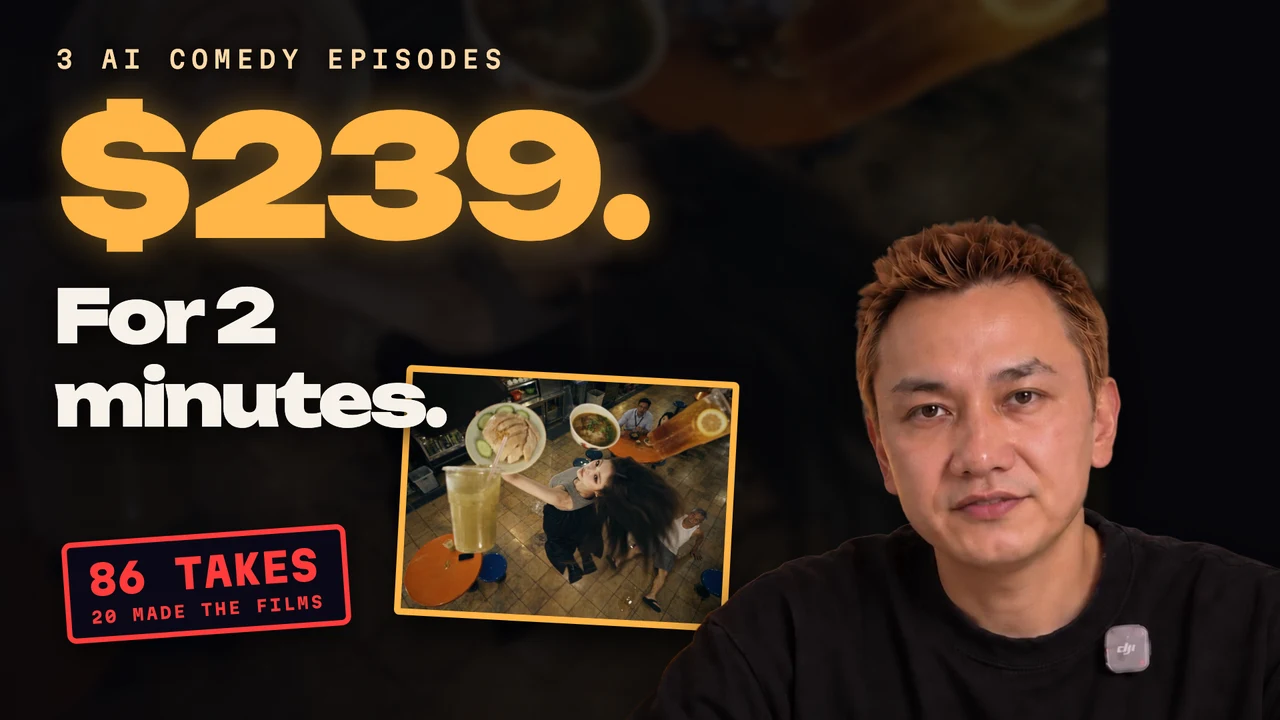
Ziela is a character generated with AI, and I've been making a short comedy series with her. Between 6 and 11 November I finished three episodes, two minutes and twenty seconds of film in all. While I was making them I had a rough idea of what each one was costing, but I never added it up. So once the third was out, I opened every log my tools had kept (paid generations, upscales, timestamps on my messages) and did the sums.
The bill was $238.51 plus about 59 hours of my own time. I paid for 86 video takes and used 20 of them. Per finished minute, that's a little over $100 and 25 hours. Below I go through each episode: what the money bought, why the price per second dropped by about two thirds after the first one, and why the hours went up anyway.
I paid for every take myself, and nobody sponsored this post or the video. My producer on all three episodes was Claude Code, which is made by Anthropic, and I build most of my work on Claude. If you're choosing between monthly plans and paying per generation, I compared the two in AI video subscription vs API. For how one person can now take on a studio, read one person beat a studio's AI movie. The series has its own case study too.
- Three AI comedy episodes cost me $238.51 and about 59 hours. They add up to 2 minutes 20 seconds of film, and 20 of the 86 video takes I paid for made the final cuts.
- Starting from a storyboard of stills was the expensive mistake. Episode one came to $102.97 against a plan of $10.40, and only about 7% of the paid footage ended up on screen.
- A 3D blockout used as Seedance's video reference cut the cost per second by about two thirds, from $3.85 on episode one to $1.12 on episode two.
- Cheaper takes didn't mean less work. My hours went from 12 to 21 to 26, because the effort moved into building 3D scenes, recording voices and checking takes.
- Three habits did the most to cut waste: hand the model a reference video rather than a still, record the dialogue before generating, and compare every take with its neighbouring shots before paying for another.
The video version. 9 min 36 sec. Watch on YouTube
- 0:00How much does AI video cost?
- 0:43AI filmmaking workflow: who does what
- 1:26Episode 1: the storyboard trap
- 3:15Episode 2: Seedance video reference and motion capture
- 6:02Episode 3: 33 takes for an AI comedy sketch
- 7:34AI video cost per second vs my hours
- 8:35Is AI short filmmaking worth it?
How much does AI video cost?
For my three episodes, it averaged $1.71 per finished second, or about $102 per finished minute, once every failed take is counted. That average hides a big spread. The first episode cost more than three times as much per second as the other two.
| Episode 1 | Episode 2 | Episode 3 | All three | |
|---|---|---|---|---|
| Finished length | 26.8 s | 43.6 s | 69.6 s | 2 min 20 s |
| Video, stills and music credits | $94.40 | $44.95 | $81.79 | $221.14 |
| Topaz upscaling | $8.40 | $3.70 | $5.10 | $17.20 |
| Other (WaveSpeed) | $0.17 | none | none | $0.17 |
| Total | $102.97 | $48.65 | $86.89 | $238.51 |
| Cost per finished second | $3.85 | $1.12 | $1.25 | $1.71 |
| Paid video takes / used | 43 / 2 | 10 / 5 | 33 / 13 | 86 / 20 |
| My hours | About 12 | About 21 | About 26 | About 59 |
What's counted: credits on poyo.ai, which I use for Seedance, OpenAI's image model and the music, at 200 credits to the dollar; Topaz's API at $0.10 a credit, the rate on my Developer plan; and 17 cents on WaveSpeed. ElevenLabs and Claude are monthly subscriptions I'd pay for anyway, so they're left out. To get my hours, I put my messages in time order and summed every gap shorter than 30 minutes.
Out of 86 paid video takes, 66 were never used. That's about three in four.
Who does what in my AI filmmaking workflow
It would be easy to call these episodes "made with Claude", but that isn't accurate. Claude Code doesn't generate a single frame of Ziela. Here's how the work is split.
| Who or what | Job |
|---|---|
| Seedance 2.5 (ByteDance) | Ziela's picture and movement in every final shot |
| OpenAI's image model | Still images: storyboard frames, reference sheets, props |
| ElevenLabs | Voices, with one fixed voice per character |
| Topaz | Upscaling the finished episodes |
| Claude Code (Anthropic) | Producer: writes the plans and prompts, builds the 3D blockouts, reviews every take frame by frame, edits the episode |
| Me | Direction and approval. No paid run goes out without my OK, and I edited one shot in episode three by hand. |
Ziela's account carries the AI label on every platform she posts to. Within the series she plays a newly hired intern at my studio.
Episode one: why storyboarding AI video cost me $103
The first episode has no dialogue. It's lunchtime in a hawker centre. An uncle slips on a wet floor, his tray goes up in the air, everything drops into slow motion and Ziela catches the whole lot. She sits down looking smug and then knocks her own juice into her lap.
I approached it like a live-action shoot. Claude broke the story into 19 shots, and each shot got a generated still that would be animated later. The first round of stills had the uncle as three different men. There was a stool nobody had placed, and the airborne cups were the same green as Ziela's drink. To stop that, Claude wrote what it called a continuity bible, with a floor plan of the room, a set seat for every extra, and a single wording for each prop that was pasted unchanged into every prompt.
The storyboard ran to seven versions and roughly 136 images. One shot alone took 20 attempts.
Next, Kling, a different video model, turned each still into a clip three seconds long. Every clip was fine in isolation. In the edit, though, each shot only had room for about a second, so the slip, the throw and the catch all happened in the gaps between cuts. My note to Claude was "i feel each sequence are disconnected."
So we switched to longer Seedance takes, which brought their own problems: rows of diners eating in perfect unison, a pair of chopsticks that became a straw, a table that slid across the floor. A little after midnight I told Claude to throw out the storyboard and start again from nothing.
The episode that went out is one continuous 22-second take, with a 3.5-second stretch in the middle replaced by a regenerated repair. It cost $102.97. The plan had estimated $10.40. Of roughly 304 seconds of video I paid for, 22 made it into the film, which is about 7%.
Two rules came out of that night, and I still follow both:
- One sequence per paid run. Don't generate the next part until the current one works.
- Regenerate, don't edit. If a shot is wrong, make a new one rather than patching the bad one.
Episode two: a Seedance video reference built in three.js
Episode two is a chase, and it has dialogue. A man with a microphone stops Ziela in the street and asks how she keeps fit. "Running. Every morning. Late." Then we see it: she ducks limbo-style beneath an auntie's umbrella, clears a fence without spilling her coffee, sprints up the escalator that's going down and lands in her desk chair at 08:59. Nobody else is in, because it's a public holiday.
I began with a storyboard again. After 121 images it still drifted: her outfit changed, her height changed, and one hand had six fingers. That Sunday afternoon, I called a halt and asked Claude for a different approach.
I'd seen 3D blockouts on video productions I'd worked on in the past. A crew builds a rough grey version of the scene, with simple stand-in figures, and works out the camera and the action in it before anything real is shot. I'd never tried one as an input for AI video. So I had Claude make one in three.js, a browser-based 3D library: real-world scale, real lens lengths, grey placeholder figures, and timing for each move down to the second.
Blender could do the same job. My reason for three.js is that the scene exists entirely as code, which Claude can write, render and test on its own. The episode two blockout came with 17 check scripts, including one that measures foot slide, the giveaway when a figure's feet skate across the ground. It measured 0.0 mm.
Seedance accepts a video as a reference. Feed it the blockout and it follows the blockout's camera and movement, which is far more information than a single still can carry. Claude built the first version in 3 hours 41 minutes, and I signed it off that evening.
Recording the voices first
Left to itself, Seedance invents a new voice for a character on every take. Across a dozen takes, Ziela would sound like a dozen different people.
The fix is to record every line in ElevenLabs before generating any video, using one fixed voice per character. Seedance gets that recording together with the blockout and lip-syncs to it. In the edit, Seedance's version of the audio is stripped out and replaced with the clean recording. In the finished episode, her lip movements land within about 0.05 seconds of the recording.
Why she moved like a robot, and the motion capture fix
The escalator sequence came back stiff and mechanical. Seedance had copied the blockout exactly, and our blockout figure had been keyframed by hand in code, so the stiffness was ours.
Claude replaced her animation with motion capture, meaning recorded movement of real people, from the free library at Carnegie Mellon University. The next take was worse. To fit the old timings, the motion clips had been sped up to between 1.22 and 1.40 times their real speed. On the third take, at normal speed, she finally ran like a person.
Some creators who use blockouts go the opposite way and swap the figures for plain capsule shapes, so the model has no body to copy. I chose to give it real human motion to copy instead.
One mistake got all the way into the final cut: in that third take the down escalator was moving up. I only noticed after the episode was assembled. Four seconds of retake sorted it out.
Episode two cost $48.65. That's under half the price of episode one, and it's the longer film, with dialogue. It also took me about 21 hours, compared with about 12 for the first.
Episode three: 33 takes for a three-person AI comedy sketch
The third episode is a prequel about the day we hired her. My co-founder Dom and I are on the other side of the desk, interviewing her for the intern role. Her opening line is "You haven't signed a new client in two months." She wants five thousand a month, and by the middle of the interview she has landed our first client over the phone. The client drought is part of the skit. This was also my first episode where three characters talk.
Ziela and Dom each got a fixed voice. Finding Dom's took four attempts. The blockout used motion capture from the beginning this time, and Claude ran 28 subagents, 27 of them reviewing the blockouts and prompts before anything was paid for.
It still needed 33 paid takes to get 55 seconds of usable footage. In one, she repeated her salary demand. In another, her hand looked as if it had six fingers.
The Seedance prompt trap: naming what isn't there
One of our fixes told Seedance the shot had "no table, hands, cup, phone or bag". The take came back with a bag, a cup, a phone and, for good measure, a laptop.
In my experience with Seedance, mentioning an object at all, even in a negative, can be enough to put it in the frame. Describe what should be in the shot and leave everything else out.
The final shot, Ziela walking out of the room, took six takes. Take one was robotic. Take two was too fast. Take three showed our hands. Take four had a twitch in her arm. Take five turned her phone the wrong way round and added a concrete wall on the side of the shot. Just before that fifth take, I asked Claude "why u keep introducing new problem". The sixth was the one we kept.
Episode three cost $86.89. Of the money spent on video, 61% went on takes we didn't use. It also took the most time of the three, about 26 hours.
AI video cost per second vs my hours
Put the three episodes next to each other and the two lines move in opposite directions.
| Method | Cost per finished second | My hours | |
|---|---|---|---|
| Episode 1 | Storyboard stills, then animation | $3.85 | About 12 |
| Episode 2 | three.js blockout as video reference, voices first, motion capture added mid-way | $1.12 | About 21 |
| Episode 3 | Blockout with motion capture from the start, three speakers | $1.25 | About 26 |
The blockout is what brought the price per second down by about two thirds. The money that used to go on paid retakes now goes into preparation: 3D scenes, voice recordings and checks, most of which run locally or sit inside subscriptions I already have. That work doesn't show up on the bill, but it does show up in my hours.
Both times Claude estimated a budget, it undershot. It planned episode one at about $10.40, and the final bill was $102.97. For episode three it estimated about $31, and the video generation alone came to $80.56. If you're budgeting with an AI assistant, take its estimate as the cost of a run where nothing goes wrong, and add a margin for retakes.
All three together: 86 paid takes, 20 in the films, $238.51 and about 59 hours. Each failure became a written rule, saved to a file that Claude reads at the start of every session, so the next episode begins with everything the last one taught us.
Is AI short filmmaking worth it?
Fifty-nine hours is over seven full working days, spent on 2 minutes 20 seconds of film. Each second is getting cheaper, while my hours keep climbing. Reading the logs back, I spent a large share of my messages pointing out what had come back wrong.
The models can already pull off a slow-motion tray catch. What they won't do on their own is keep the uncle looking like the same man from shot to shot. Someone has to check. For now, that checking is where most of my time goes, and I don't think it's going away soon.
If you're about to try a short AI film, these three habits saved me the most money:
- Hand the model a reference video, not a still. A blockout shows the camera, timing and movement all at once.
- Record all dialogue before any video generation. One fixed voice per character, used as the lip-sync source and laid back over the edit.
- Compare every take with its neighbouring shots before paying for another. A take that looks fine by itself can still break the cut.
Label it as AI
I'd label any AI character, not only Ziela. YouTube added an in-player label for AI content in May 2026 and tightened its monetisation rules on inauthentic content in July. TikTok has required a label on realistic AI-generated people since 24 September. Instagram has reportedly started marking some accounts with an "AI-generated" profile label.
You can watch Ziela on Instagram and TikTok. Before you budget your next AI video, go back and count every take your last one cost.
Frequently asked questions
How much does AI video cost?
In my case, $238.51 for 2 minutes 20 seconds of finished AI comedy across three episodes, about $1.71 per finished second or $102 per finished minute. That counts every failed take, 66 of the 86 I paid for, plus upscaling, but not ElevenLabs or Claude subscriptions. It also took about 59 hours of my time.
How much does Seedance 2.5 cost per finished second?
It depends mostly on how many takes you throw away. My first episode, built from storyboard stills, came to $3.85 per finished second. Once I gave Seedance a 3D blockout as a video reference, it fell to $1.12 on episode two and $1.25 on episode three.
Why do most AI video takes get thrown away?
Models drift. Across my three episodes I saw characters change face, extra fingers, props appearing from nowhere, an escalator running the wrong way and robotic movement. Each problem means a new paid take, which is why only 20 of my 86 takes made the final cuts.
What is a 3D blockout for AI video?
A rough grey 3D version of the scene with stand-in figures, real distances, real lens lengths and timed movement. I had Claude Code build mine in three.js, rendered it to video and gave it to Seedance as a reference, so Seedance copied its camera and motion instead of guessing from a still image.
How do you keep an AI character's voice consistent?
Record every line first in ElevenLabs with one fixed voice per character. Give that recording to the video model with the reference so it lip-syncs to it, then lay the clean recording back over the take in the edit. My lines landed within about 0.05 seconds of the recording.
Why does Seedance add objects I told it to leave out?
In my experience, naming an object at all can make it appear. A prompt saying "no table, hands, cup, phone or bag" came back with a bag, a cup, a phone and a laptop. Describe what should be in the shot and leave everything else unmentioned.
Can Claude Code make AI videos?
Not on its own. In my workflow Claude Code is the producer: it writes plans and prompts, builds the 3D blockouts, reviews every take frame by frame and edits the episodes. Seedance and OpenAI's image model generate the picture, ElevenLabs generates the voices and Topaz upscales the result.
Do you have to label AI-generated videos?
On the big platforms, increasingly yes. YouTube asks creators to disclose realistic altered or synthetic content and added an in-player AI label in 2026, and TikTok has required labels on realistic AI-generated people since 24 September 2026. I put the AI label on every one of Ziela's posts.
Sources
Costs and hours come from my own generation logs and session transcripts for the three episodes, made between 6 and 11 November 2026. Prices are what I paid at the time.
- The AI labels: YouTube on its AI labels, YouTube Help on disclosing altered or synthetic content, TikTok's rules on AI-generated content, FoneArena on Instagram's AI-generated profile label
- Tools and prices: poyo.ai pricing, BytePlus on Seedance pricing, ElevenLabs pricing, Topaz Labs API
Motion capture: the data used in this project was obtained from mocap.cs.cmu.edu. The database was created with funding from NSF EIA-0196217.
Get the next post
New writing on AI and creative technology. No spam, unsubscribe anytime.
Delivered by Substack
Keep reading

Creative technologist and AI Forward Deployed Creative at Original Copy Studio.