Claude Opus 5.5 vs Sonnet vs Haiku: Which One to Use
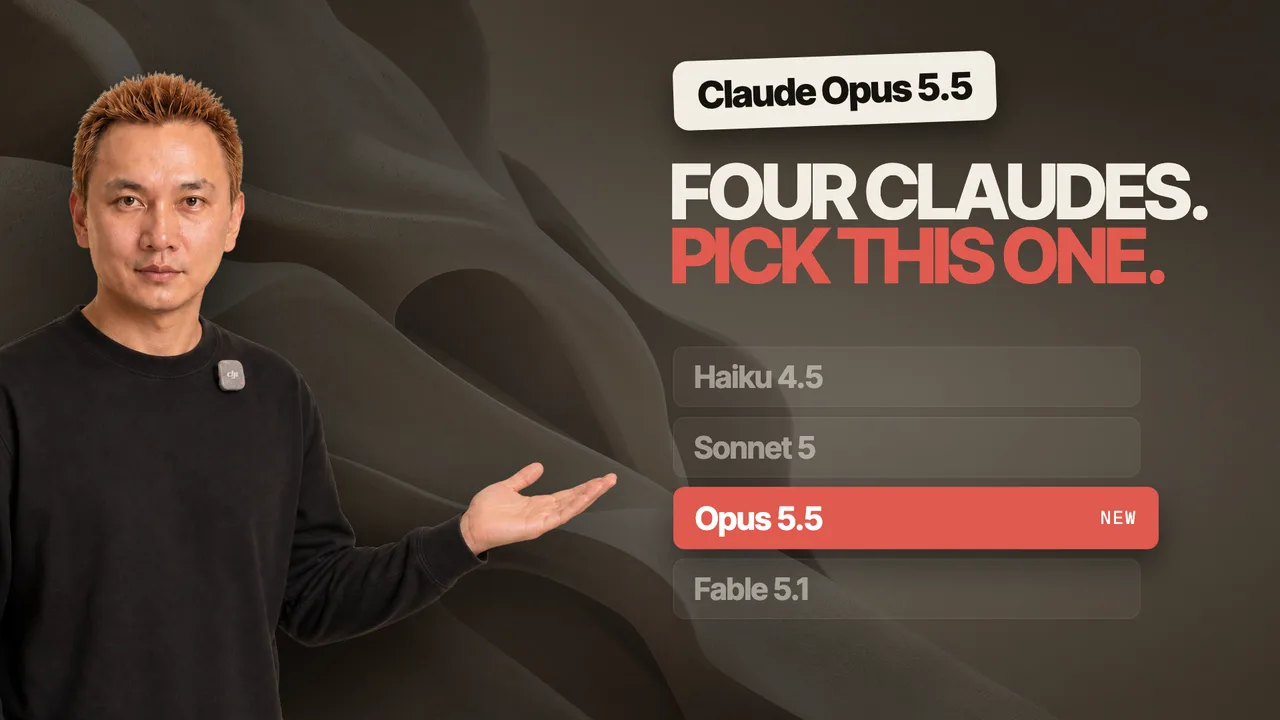
Open the model dropdown in Claude and there are four names waiting: Haiku, Sonnet, Opus and Fable. The list offers no help whatsoever. Nothing marks one as recommended, nothing separates the cheap option from the one that will eat your quota, and most people simply leave whatever was already selected.
Anthropic added the newest of the four on 22 September. Opus 5.5 is now their leading model, and it changes the right answer to a question most people never get around to asking: which one should be selected?
Below is what genuinely improved, what did not, and which of the four to pick for the work you do. Every figure here was checked against Anthropic's own pages on 23 September 2026. Pricing and plan limits move, so treat the shape as durable and verify any number before you spend against it.
The video version, with every screen shown. 7 min 49 sec. Watch on YouTube
- 0:00Four Claudes
- 0:28What it is
- 1:03It writes like a person now
- 2:10It makes things up less
- 3:01It finishes things
- 3:59Faster and cheaper
- 4:39What it still can't do
- 6:06Which one to pick
- 7:22The honest version
- On a paid plan, select Opus 5.5. Anthropic's own documentation now says to start there if you are unsure.
- On the free plan you have no choice. Neither Opus nor Fable is available; Sonnet is your everyday model.
- The headline improvement is honesty. On Anthropic's fabrication test it passed 16 of 18. Opus 5 and Fable 5.1 passed none.
- It also reads like a human wrote it, runs over 30% faster, and costs around 40% less on typical work.
- It still cannot generate images, browser control is uneven, and GPT-6 Astra beats it on two of Anthropic's own benchmarks.
What is Claude Opus 5.5?
Claude Opus 5.5 is Anthropic's current leading model, released on 22 September 2026. It replaces Opus 5, which had been out for roughly two months, and it is the first release in a new Claude 5.5 family. Sonnet 5.5 and Haiku 5.5 will follow with many of the same improvements; Anthropic will commit to nothing firmer than "in the coming weeks", so no date is worth inventing.
It is already available across the apps, the web interface, Claude Code, and all three major clouds. On a paid plan there is nothing to install or enable. You select it from the dropdown.
Claude Opus 5.5 vs Sonnet vs Haiku vs Fable
Four models, one line each, before the detail:
| Model | Use it for | Trade-off | Plan |
|---|---|---|---|
| Haiku 4.5 | Simple, high-volume, repetitive work | Fastest and cheapest; oldest of the four, so it knows least about recent events | Free and up |
| Sonnet 5 | Everyday work, and anything where speed matters | Quick and capable, at a fraction of the price of the two large models | Free and up |
| Opus 5.5 | The default for most paid users | Slower than Sonnet, considerably stronger; $4 and $20 per million tokens | Pro and up |
| Fable 5.1 | The hardest reasoning problems | Slowest of the four, and priced at $10 and $50, roughly 2.5x what Opus 5.5 costs | Pro and up, drawing on extra credits |
The important line in that table is the plan column. If you are on the free tier, three quarters of this decision is already made for you.
What changed in Opus 5.5
It stopped writing like a robot
Anthropic say readability was one of the most common pieces of feedback on the previous model. Answers ran long, reached for jargon, and buried the point.
They published a before and after on the same bug report. The older model's reply opens with a commit reference, then a block of code, then a definition, then an operator, with the conclusion arriving somewhere near the end. The new one leads with the conclusion: a customer's bill dropped because of a bug in the billing code, the amount was $9.92, and here is the cause.
Both replies identify the same bug. Only one of them expects you to excavate it.
The verbal tics are quieter too. Anthropic describe it as less inclined to reach for jargon or idiosyncratic phrasing, and it now follows the writing instructions you hand it. One early tester summed it up as "it writes the way I do".
It makes things up less
This is the change that matters most, and the one you are least likely to notice, because a fabricated figure looks identical on the page to a real one.
Anthropic built a test aimed squarely at it. Three models were asked to write a report on a company's earnings, working from a copy of the internet in which the actual earnings release was hard to locate. A grader then checked every number and every quotation against the source material. One invented figure failed the entire report.
Opus 5.5 passed sixteen of eighteen attempts. Opus 5 and Fable 5.1 passed none at all.
If you use Claude for anything you then hand to someone else, a summary, a client email, coursework, a report that carries your name, that gap is the argument for switching.
It finishes long jobs
These tools have always been better at answering a question than at completing a task. Hand one a whole job and walk away, and you would usually return to find it had stopped somewhere in the middle.
A developer at Clio gave Opus 5.5 work spanning six repositories and left it running overnight. It worked unattended for more than eighteen hours. A team at Quantium had a job that previously took thirty-eight back-and-forth messages across four days; the same job came back in eleven prompts over three hours.
It audits itself as well, which is the part I did not expect. Engineers at Column described it catching a misconfiguration introduced several commits earlier by going off and reading the third-party documentation for the integration in question.
You do not have to write software for that distinction to matter. A tool that needs supervising and a tool you can delegate to are different products, whatever the job is.
It is faster and cheaper
Output arrives more than 30% faster than from the model it replaces, and running it costs roughly 40% less on typical workloads.
Paying per use, that works out at $4 and $20 per million tokens in and out, down from $5 and $25. On a subscription it reaches you as headroom rather than as money: Anthropic raised the five-hour usage caps on Pro, Max, Team and seat-based Enterprise, and added a limit reset you can bank and spend when you actually need it.
What Claude Opus 5.5 still cannot do
Three limits worth knowing, because at least one launch-week review presented it as beating everything.
It cannot generate images. Claude reads images you give it perfectly well, but it cannot produce one. ChatGPT ships with its own image model, so a request for a picture returns one without leaving the conversation. There is a route around it: Claude can be wired to an outside image service through MCP, an open standard that works like a universal socket for connecting tools. That works, but it is a configuration job rather than a button, and most people will never set it up.
Browser control is uneven. Reviewer Peter Yang set it a deliberately awkward task: drive a browser-based Paint clone and produce a portrait. The output was poor. He ran the identical test against OpenAI's newest model and could not decide which result he disliked less, so this reads as an unsolved problem across the field rather than a Claude weakness. The picture is not one-sided either: on OSWorld, Anthropic's own computer-use benchmark, Opus 5.5 leads at 81.8%.
GPT-6 Astra still wins two categories on Anthropic's own published scoreboard. Business automation goes to Astra, 41 to 40, and science work goes to Astra by a wider margin, 65 to 59. Anthropic printing the losses in their own announcement is a decent signal in itself.
There is also a capability restriction, which will not affect you but explains an odd behaviour if you ever hit it. Anthropic rate its capabilities in security and biology high enough that professional work in either field gets routed to an older model. Vetted biology researchers can apply for access now, and the equivalent programme for security teams is still in the coming weeks. Ordinary use never reaches that boundary.
Which Claude model should you use?
Anthropic now answer this themselves, at the top of their model documentation: if you're unsure, start with Opus 5.5.
For the first time the house recommendation points at the cheaper of the two large models rather than the flagship.
By plan, in full:
- Paid plan: use Opus 5.5 for most things. Drop to Sonnet when you want a fast answer more than a careful one.
- Free plan: the decision is made for you. Neither Opus nor Fable is available, so Sonnet is your everyday model and Haiku is there for volume.
- Fable 5.1: reach for it only when Opus 5.5 has already fallen short. At roughly 2.5x the cost, and drawing on extra credits if you are on Pro, it is not a default worth leaving selected.
If you have never opened that dropdown, and you are paying for Claude, changing it is a single click and probably the highest-value minute you will spend on the tool this month.
The honest version
It is easier to read, more honest and cheaper than the model it replaces, which is an unusual combination to get in one release. It is not a leap.
What I would actually tell a friend is narrower than the announcement: it lies to you less, and when it does slip, you stand a better chance of catching it, because you can follow what it wrote.
If the model menu was the first thing that confused you about Claude, it will not be the last. I wrote a complete beginner's guide to Claude covering all six levels of using it, from writing a decent prompt through to handing it a folder and walking away.
Frequently asked questions
What is Claude Opus 5.5?
Claude Opus 5.5 is Anthropic's current leading model, released on 22 September 2026. It replaces Opus 5 after roughly two months and opens a new Claude 5.5 family, with Sonnet 5.5 and Haiku 5.5 to follow carrying many of the same improvements. It is available in the Claude apps, on the web, in Claude Code and across AWS, Google Cloud and Azure.
Is Claude Opus 5.5 available on the free plan?
No. Anthropic's plan table lists Opus as unavailable on Free and available from Pro upward, and Fable is restricted the same way. On the free tier your practical choices are Sonnet for everyday work and Haiku for high-volume repetitive tasks. If you are paying, Opus 5.5 needs nothing installed or enabled; you select it from the model dropdown.
Claude Opus 5.5 vs Sonnet: which should I use?
On a paid plan, Opus 5.5 for most work and Sonnet when speed matters more than depth. Anthropic's own model documentation now opens by telling unsure users to start with Opus 5.5, which is notable because it points at the cheaper of the two large models rather than the flagship. Sonnet remains quick, capable and a fraction of the price, so it stays the right pick for fast iteration and high volume.
What is the difference between Opus 5.5 and Fable 5.1?
Fable 5.1 is the heavyweight, built for the most demanding reasoning, and it is the slowest of the four. It also costs $10 and $50 per million tokens in and out against Opus 5.5 at $4 and $20, so roughly two and a half times as much, and on Pro it consumes extra credits. Opus 5.5 beats Fable 5.1 on all nine benchmarks listed in Anthropic's announcement, so Fable is now a fallback for when Opus 5.5 has already fallen short rather than a default.
How much does Claude Opus 5.5 cost?
Through the API it is $4 per million input tokens and $20 per million output tokens, down from $5 and $25 for the model it replaces, and roughly 40% cheaper to run on typical workloads. On a subscription the saving arrives as capacity rather than a lower bill: Anthropic raised the five-hour usage caps on Pro, Max, Team and seat-based Enterprise and added a limit reset you can bank and spend later.
Does Claude Opus 5.5 hallucinate less?
Measurably, on Anthropic's own test. Three models were asked to write a report on a company's earnings from a copy of the internet where the earnings release was hard to locate, then a grader checked every figure and quotation against the source, with one invented number failing the whole report. Opus 5.5 passed sixteen of eighteen attempts. Opus 5 and Fable 5.1 passed none. That matters most if you pass Claude's output to someone else.
Can Claude Opus 5.5 generate images?
No. Claude can read and interpret images you upload, but it produces text only, which is the clearest functional gap against ChatGPT and its built-in image model. You can connect Claude to an external image service through MCP, the open standard for wiring tools to models, and it will fetch you one. That is a configuration exercise rather than a button, so most people will not set it up.
Is Claude Opus 5.5 better than GPT-6 Astra?
Not universally, and Anthropic publish the losses themselves. On their own scoreboard GPT-6 Astra leads on business automation, 41 to 40, and on science work by a clearer margin, 65 to 59. Opus 5.5 leads elsewhere, including OSWorld computer use at 81.8%. Browser control remains rough across the field: one reviewer ran the same drawing task on both models and could not say which result was worse.
When are Claude Sonnet 5.5 and Haiku 5.5 coming?
Anthropic have committed only to 'in the coming weeks', with no date given. They have said the cheaper and faster models will carry many of the same improvements when they arrive, which is worth factoring in if you are currently choosing between paying for Opus 5.5 and waiting.
Which Claude model should most people use?
If you pay for Claude, select Opus 5.5 and leave it there, dropping to Sonnet when you want a fast answer rather than a careful one. If you are on the free plan, Sonnet is your everyday model because Opus is not offered. Reserve Fable 5.1 for problems Opus 5.5 has already failed at. The most common mistake is never opening the dropdown at all and running for months on whatever was selected by default.
Sources
Every figure above was checked against Anthropic's own pages on 23 September 2026. Prices and plan limits change, so verify the current number before you spend against it.
- Anthropic, introducing Claude Opus 5.5
- Anthropic, model overview and comparison table
- Claude plans and pricing, including model access by plan
Get the next post
New essays on AI, creative technology, and building at the edge. No spam, unsubscribe anytime.
Powered by Substack